


Last Updated on April 6, 2026 by Carrie Korem, FNTP
What are the optimal TSH levels for Hyperthyroidism? It’s important to keep a close eye on your TSH as well as your thyroid hormone levels when you are hyperthyroid. Let’s dive in.
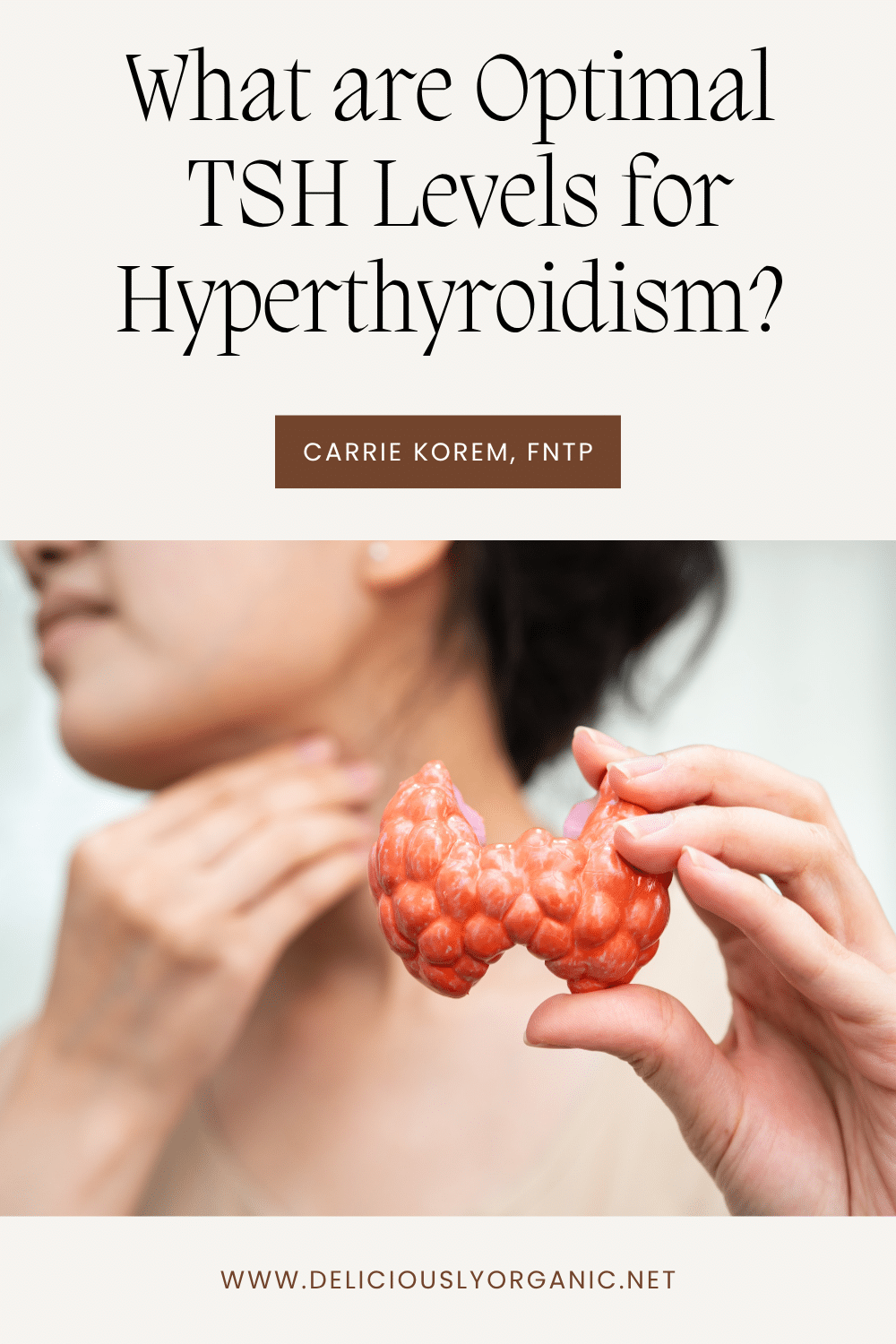
What is TSH?
TSH (thyroid stimulating hormone) is a pituitary hormone that is sent out to tell the thyroid how much or how little thyroid hormones to produce.
It’s important to understand that TSH is a pituitary hormone, not a thyroid hormone.
What TSH level is considered hyperthyroidism?
A TSH <.5 mIU/L is considered too low.
What are Optimal TSH Levels for Hyperthyroidism?
Everyone is biochemically individual, but at that a TSH level between 0.5-2.0 is the optimal range where people feel healthy and vibrant.
Is TSH is a thyroid hormone?
No. TSH is a pituitary hormone.
How is hyperthyroidism diagnosed?
Hyperthyroidism is most often diagnosed when TSH (thyroid stimulating hormone) levels are low and free T4 and/or free T3 levels are high.
It is common for someone to be diagnosed hyperthyroid by only testing TSH (a pituitary hormone). So, it is always recommended to get a full thyroid panel so you can know if your thyroid hormones such as fT4 and fT3 are also elevated.
Here are two of the basic thyroid hormone levels to talk to your doctor about:
fT4
Free T4 is a hormone produced by the thyroid.
You want free T4 to be in the middle of the lab range. So if the range is 1.0-3.0, you want your free T4 to be 2 or close to it. Each lab has a different range, so you have to look at what the specific range is to know what number to look for.
fT3
Free T3 is a hormone that mostly comes from T4. The thyroid makes T4 and sends most of it to the liver to be converted to free T3.
You want free T3 to be in the middle of the lab range. So if the range is 1.0-3.0, you want your free fT3 to be 2 or close to it. Each lab has a different range, so you have to look at what the specific range is to know what number to look for.
Low TSH level symptoms
Here’s a list of some of the most common symptoms of low TSH:
- Nervousness
- Irritability
- Increased sweating
- Heart racing
- Hand tremors
- Anxiety
- Difficulty sleeping
- Thinning of your skin
- Fine brittle hair
- Increased sensitivity to heat
- Weakness in your muscles—especially in the upper arms and thighs.
- More frequent bowel movements
- Weight loss
- Excessive appetite
- Irregular Menstrual cycles
- Lots of energy (often too much)
- Lack of energy (as the body breaks down)
- Bulging Eyes
- Goiter
- Graves Disease
What’s more important – T4, T3 or TSH?
All three are very important.
TSH is a pituitary hormone that signals to the thyroid how much or little thyroid hormone to produce.
fT4 is produced by the thyroid and a portion of this is converted into fT3. fT3 goes to every cell of the body, so it’s an important thyroid level to keep an eye on.
Can Hyperthyroidism go back to normal?
Yes. The body can move out of the hyperthyroid state and produce optimal thyroid and TSH hormones again. I saw this happen for myself when I was stuggling with thyroid disease and I’ve seen it happen over and over for clients. The key is working on the root causes. Tap here to learn about natural steps you can take for Hyperthyroidism.
If you have Graves’ disease, tap here for natural steps you can take to work on the root causes.
When to see a doctor
Always work with a doctor when you have hyperthyroidism. The body is in a state of overdrive and it’s so important to be closely monitored.
I’ve worked with many clients who were diagnosed with hyperthyroidism and they were under the care of their doctor while we worked together on their root causes. You can take holistic and conventional steps for your thyroid at the same time!
How Can I Learn More?
I have four great options for you, depending on where you are in your journey:
- Download my free guide with 50 of my top tips to support the thyroid and immune system naturally. I’ll also send you helpful educational emails to keep you learning.
- Take my free class, “5 Keys to Thyroid Hormone Balance.” It’s just 45 minutes and packed with things you can start using right away.
- If you’re ready for a full step-by-step plan, check out my 90-Day Thyroid Reset Program. No more piecing together random information!
- Book a one-on-one consult with me for personalized support. Here’s what working together looks like.
Note: This post is meant to give an overview of hyperthyroidism and TSH from a holistic perspective and is not intended to replace your doctor’s advice.

