


Highway travel offers unmatched freedom. But sharing the road with 80,000-pound commercial trucks? That requires a whole different level of awareness behind the wheel.
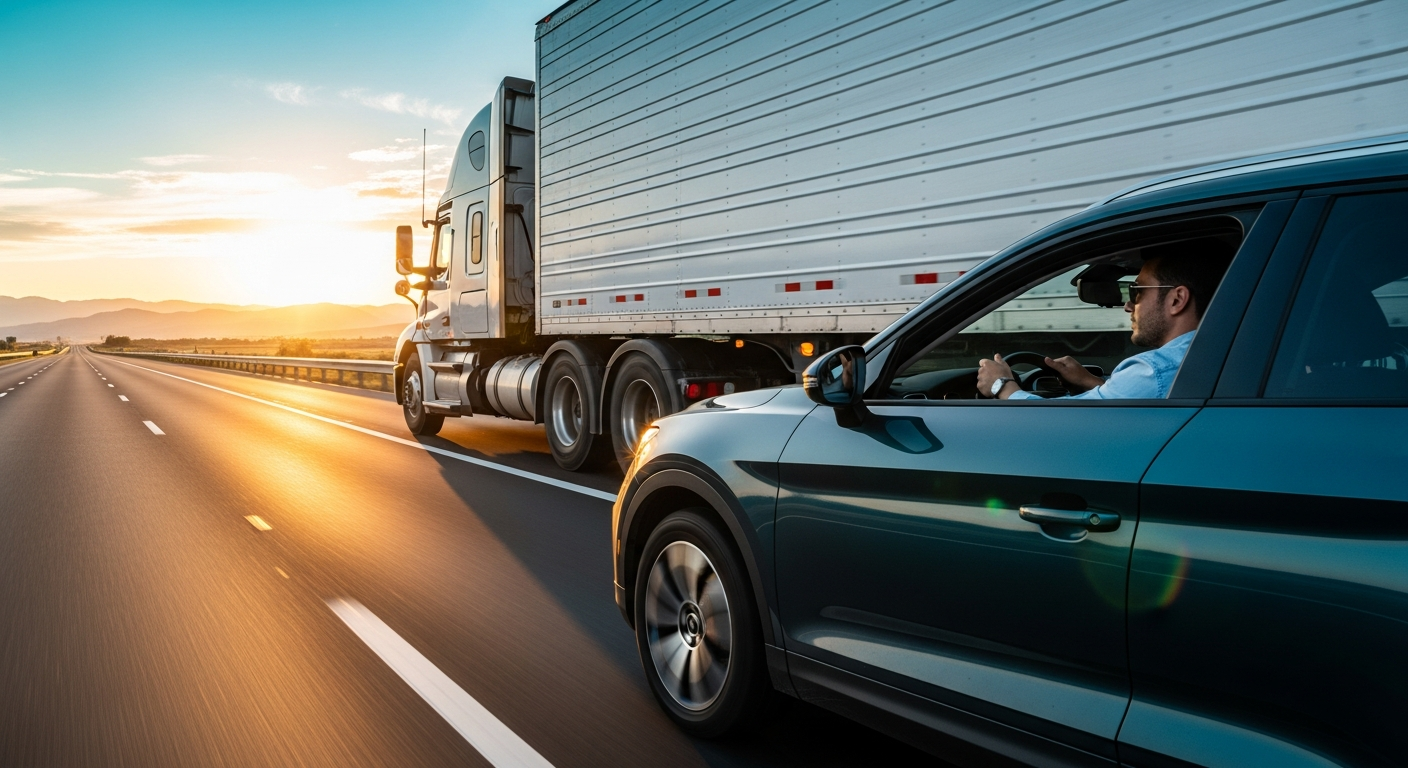
The stakes are real. Large truck crash fatalities were 38% higher in 2023 than in 2009. And NHTSA data shows roughly 153,452 people were injured in large truck crashes that same year, averaging about 420 injuries per day. If you’re planning a cross-country drive, these seven hacks will help you stay safe around big rigs.
The Physics Working Against You
Hack 1: Stay Out of the “No-Zones”
Commercial trucks have four massive blind spots, often called “No-Zones.” They cover the area directly in front of the cab, behind the trailer, and wide swaths along both sides. When your car sits in one of these zones, the trucker literally can’t see you.
Rear-end crashes are among the most common types of 18-wheeler accidents, partly because tractor-trailers need significantly more stopping distance than passenger cars. So don’t cut in front of a big rig too closely. And if you’re following one, leave plenty of room. When highway traffic suddenly grinds to a halt, that buffer could save your life.
Hack 2: Give Trucks Room on Right Turns
Ever noticed how a semi swings wide to the left before making a right turn? That’s not a mistake. The truck’s geometry demands a huge turning radius, and that leftward swing creates a deceiving gap on the right side.
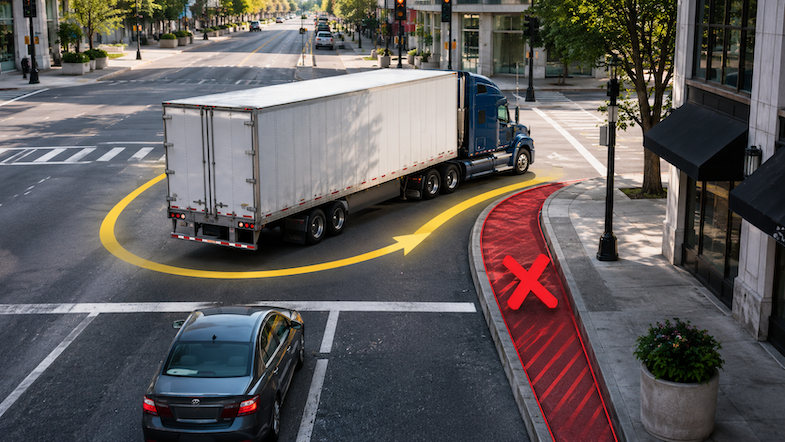
Never attempt to squeeze between a turning truck and the curb. Just wait. Patience costs you a few seconds; getting caught in that gap could cost you everything.
|
Vehicle Feature |
Passenger Car |
Loaded 18-Wheeler |
Safety Implication |
|---|---|---|---|
|
Average weight |
~4,000 lbs |
Up to 80,000 lbs |
Collision force drastically higher |
|
Stopping distance (65 mph) |
~300 feet |
~525 feet |
Requires large front buffer |
|
Blind spots |
Minimal, easily checked |
4 large “No-Zones” |
Cars can become invisible |
|
Center of gravity |
Low |
High |
Trucks prone to rollovers |
Smarter Highway Maneuvers
Hack 3: Pass Quickly and Decisively
Don’t linger side-by-side with a big rig. Pass on the left, maintain a steady speed, and get through the truck’s lateral blind spot as fast as you safely can.
Why does this matter so much? A recent semi collision on Highway 166 completely shut down traffic, with detached cabs and fuel leaks scattered across the road. Quick, precise passing isn’t optional out there.
Hack 4: Brace for Wind Shear
A big rig moving at highway speed pushes a serious wall of air. When you pass one (or one passes you), expect a sudden gust that can shove your car sideways. It catches many drivers off guard.
Keep both hands on the wheel and stay mentally prepared before you start a pass. Overcorrecting with a jerky steering reaction is what turns a gust into a real problem.
Hack 5: Watch for Fatigued Drivers
Tired truckers are a genuine hazard. According to FMCSA data, roughly 13% of crashes involved a fatigued driver. Nighttime driving makes it worse; a 1:30 a.m. rollover on I-80 near Lovelock is a recent example.
If you spot any of these warning signs, back off and give that truck extra room:
- Drifting across lane lines or hitting the shoulder rumble strips
- Inconsistent speeds, like slowing way down, then suddenly accelerating
- Jerky lane changes or overcorrecting
- Not dimming high beams for oncoming traffic
Handling Hazards and the Aftermath
Hack 6: Keep Your Distance in Bad Conditions
Unsecured cargo and tire blowouts are unpredictable and potentially deadly. Give yourself at least a four-second following distance behind any commercial trailer, more in rain or at night.
A pile-up caused by debris on the Turner Turnpike and a hazmat spill on US-98 in Lakeland both show how fast a normal drive can turn dangerous. Distance buys you the reaction time to brake or steer clear.
Hack 7: Know What to Do After a Collision
If the worst happens, move to safety and call 911 immediately. Document the scene with photos, swap insurance info, and get checked out by a doctor, even if you feel fine. Some injuries don’t show symptoms right away.
Truck accident liability is more complicated than a typical fender-bender. The trucker might be at fault, but so might the trucking company (for pushing illegal hours), the maintenance crew (for skipping brake repairs), or even a parts manufacturer. Multiple parties often share responsibility.
That complexity is exactly why defensive driving goes such a long way toward avoiding 18 wheeler car accidents in the first place. But if you or someone you care about does get hurt, it’s worth talking to an attorney who handles commercial trucking cases. Insurance adjusters tend to move fast to minimize payouts, and having experienced legal help can make a real difference.
Making It to Your Destination in One Piece
Defensive driving is your single best tool when you’re sharing the highway with big rigs. Physics will always favor the heavier vehicle, and no amount of being “in the right” changes that equation.
So before your next road trip, take a few minutes to review these habits. Give trucks the space they need, stay alert, and keep your head on a swivel. That’s the kind of insurance policy no one can sell you.

