


This post may contain affilliate links. It means that if you buy something through one of these links, we might get a small commission at no extra cost to you. Affiliate commission helps us keep this travel blog running.
We booked this trip last minute. We needed a break — it was early March, London was grey and relentless, and we just wanted somewhere warm. Tenerife felt like the obvious answer: four and a half hours from London, reliably sunny, and easy enough to navigate with a fourteen-month-old. Here’s our honest review of Dreams Tenerife with a baby!
We were, in several ways, wrong about the reliably sunny part. But more on that shortly.
This is our honest account of Dreams Tenerife Resort & Spa in Costa Adeje, travelling with Mila at fourteen months old — what worked, what didn’t, and what I’d do differently.
Tenerife vs Gran Canaria: What to Expect
We’d been to Gran Canaria about ten years ago — fresh out of university, Ryanair flights, shared Airbnb, public buses everywhere, eating cheaply and loving every minute of it. The island felt authentic, the beaches were spectacular, and Las Palmas was genuinely beautiful. We were blown away.
We expected something similar from Tenerife. We were, in some ways, slightly off.
Tenerife is more touristic — or at least it feels more touristic, particularly in the south where most visitors stay. The resort towns in that area, including Costa Adeje where we stayed, are purpose-built for holidaymakers. They didn’t exist organically — they were constructed specifically to house tourists, and they feel like it. That’s not necessarily a bad thing, but it’s a different experience to the authentic island feel we remembered from Gran Canaria.
Santa Cruz, the capital of Tenerife, apparently has less impressive beaches than Las Palmas — several people told us they found it disappointing — so we didn’t base ourselves there. Instead we went straight to Costa Adeje, which is served by the south airport, separate from the north of the island even though Tenerife isn’t particularly large.
The Weather: We Were Unlucky (But Know the Risks)
March is usually a reasonable time to visit — typically around 19-22°C and sunny, not scorching but warm enough to enjoy. The three weeks surrounding our trip, however, experienced some sort of unusual cold snap. The week before us was stormy, cold, and extremely windy. Our week was not much better. The week after was the same.
Out of seven days, four had temperatures of 15-16°C. Only one day hit 22°C. One day reached 20°C. One day was 18°C but at least sunny. The rest were grey, windy, and at times genuinely no warmer than London at that time of year — which felt deeply unfair given that we’d specifically gone to escape London.
We still enjoyed changing environment and discovering somewhere new. But it didn’t really feel like a holiday in the sun, and that matters when you’ve travelled with a fourteen-month-old specifically for some warmth and outdoor time.
If you’re going to Tenerife, late April through October is safer for guaranteed warmth. March can go either way.
Flying to Tenerife with a 14-Month-Old
The outbound flight was genuinely one of our smoothest yet — and we’ve had a few to compare against by now.
We were lucky enough to have snagged business class tickets on British Airways using Avios, paying almost nothing extra on top of accumulated points. In BA business class on this route the seats are the same as economy — there are no lie-flat beds on a four-and-a-half hour flight — but crucially, the configuration gave us a spare seat between us, which is where Mila sat. She had space, we had space, and everything felt manageable before we’d even taken off.
We gave her a snack before boarding, and at takeoff she fell asleep. She slept for two solid hours. When she woke up we fed her, changed her — the changing facilities were fine — and got out the busy board book we’d specifically bought new for the trip. New toys are a revelation on flights: she’d never seen it before, so it kept her entertained for the remaining two hours almost entirely on its own. She didn’t cry once. It was, by any measure, a perfect flight.
The return was a different story entirely, and I want to be honest about it because it was genuinely stressful.
We were in economy on the way back, though we got lucky with a spare seat in our row again — so practically the same setup. The flight was scheduled for around 7pm but delayed by about forty minutes, pushing takeoff to 8pm. Mila usually falls asleep between 8 and 9pm. By the time we were in the air, she was overtired, overstimulated after a full day, and completely wired.
We couldn’t find milk in the airport, and British Airways didn’t have any on board, so she missed her evening milk — which on a normal night helps her wind down. The crew in our section were laughing and talking loudly right behind us, which didn’t help. The lights were never dimmed. It was stuffy and warm. We tried everything — feeding her, covering her with a blanket to block the light, rocking her — and she cried for about fifteen minutes, sweating, unable to settle, while people around us stared.
She eventually fell asleep just before 10pm. But it was one of those experiences that genuinely makes you reconsider travel logistics. An extra seat makes an enormous difference at this age. Flying at the right time of day makes an enormous difference. A shorter flight makes an enormous difference. These things feel like luxuries but they’re actually just risk management when you have a toddler who needs to sleep.
We have a flight to Pisa coming up, also in the evening. I’m already slightly anxious about it.
Dreams Tenerife Resort & Spa: The Honest Review
We had three options within our budget: Iberostar Selection, Hard Rock Hotel, and Dreams. The deciding factor was the room. Travelling with a baby — especially one like Mila who is extremely light-sensitive and needs genuine darkness to sleep — a standard double room simply doesn’t work. You need either a separate sleeping area, a walk-in wardrobe like we had at Cullinan Sea in Turkey, or a living room with enough separation that you can put the baby down and still exist as adults.
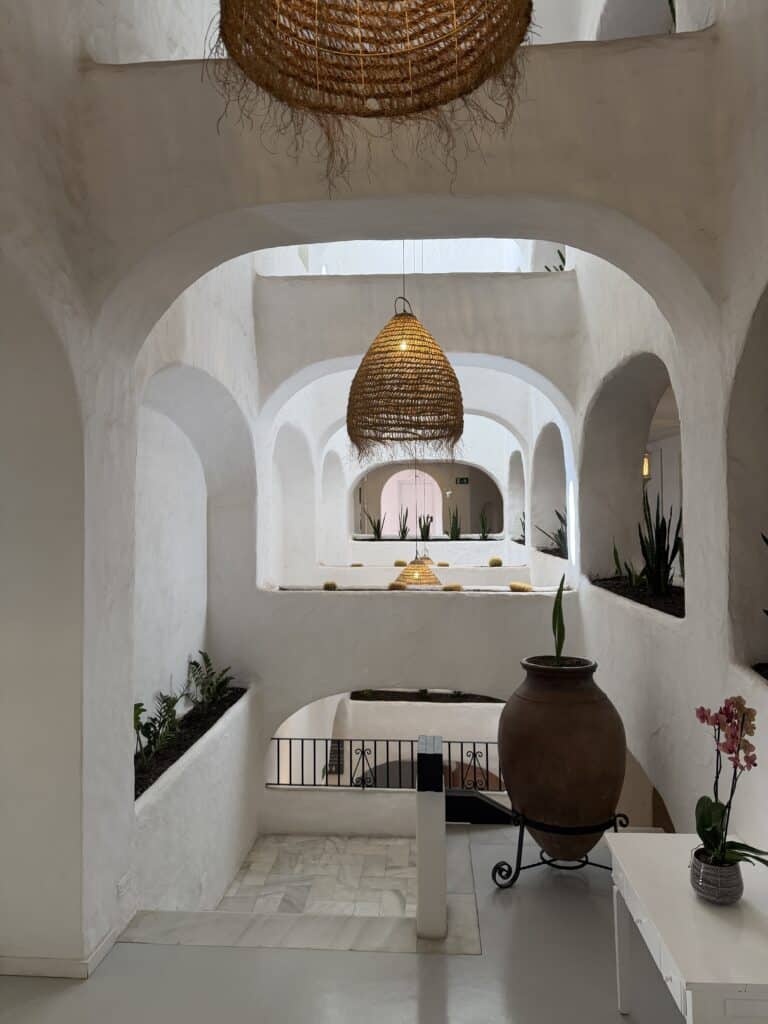
Dreams had a suite with a separate living area for around £3,000 for seven nights including half board. The regular room was around £2,000. We went for the suite, which felt expensive — particularly compared to what £3,000 gets you in Turkey — but the room itself was genuinely good. Large, clean, well-laid-out. There was a bedroom, a living area, and a covered balcony that functioned as a second sitting room — glassed in to protect against the wind, which in Tenerife is a practical necessity.
The only aesthetic downside was that the covered balcony and aggressive housekeeping — curtains closed twice daily, day service and night service both — made the whole suite feel quite dark and cave-like. It suited Mila perfectly. For us, it felt like we were permanently in a den. We left tips every day trying to communicate that we’d like some natural light; the curtains kept getting closed. In the end we left €15 in the room and accepted our fate. The cleaning itself was genuinely excellent throughout.
We were also in the Preferred Club category, which comes with meaningful perks worth knowing about.
Dreams Tenerife Preferred Club: Is It Worth It?
Yes — with one major caveat about timing.
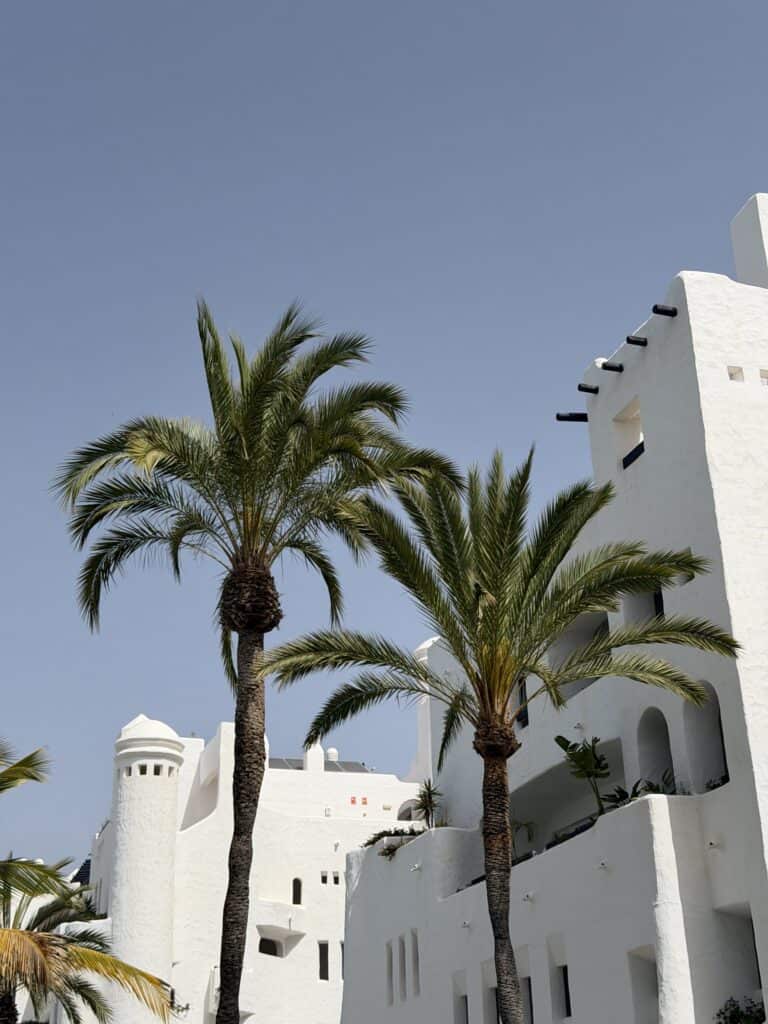
The Preferred Club perks include a separate reception, lounge access with snacks and drinks at set times throughout the day, and — most importantly — access to the Bali bed area. These are the large, cushioned outdoor daybeds with what are genuinely spectacular views over the hotel and coastline. They’re extraordinarily comfortable and the views alone justify the upgrade.
The catch: there are not enough of them for all Preferred Club guests. The best ones are gone by 7am. By 8:30 or 9am, around half remain. By 10am, all gone. You need to decide each morning how much you want one versus how much you want to sleep.
Beyond the Bali beds, there are also Preferred Club sun loungers in the same area which are significantly nicer than the general pool loungers — padded rather than plastic — and the area itself is far less crowded than the main pool zone, which at peak times feels genuinely sardine-like.
The Preferred Club breakfast lounge was the highlight of the entire stay. Rather than the main buffet — which we tried once, found chaotic and queued and overwhelming, and never returned to — the lounge offered a small but considered menu with everything prepared fresh to order. Eggs Benedict, crepes, pancakes, scrambled eggs, avocado toast, Spanish tortilla — whatever you wanted, made in front of you. The service was warm, unhurried, and genuinely lovely. High chairs were available, though only two or three, so arrive early if you need one.
We had breakfast in the lounge every single morning. It was, without question, the best part of the hotel.
The Pool Situation
Theoretically heated to 29-30°C. In practice, according to my watch which measures water temperature, it was sitting at around 26°C. On the warmer days that was fine. On the cooler days it felt cold, and on those days swimming simply wasn’t an option — for us or for Mila.
The pool is also the deepest I’ve ever encountered at a hotel. There is one small area where you can stand. The rest is so deep you could practically dive from a board. I genuinely don’t understand the design logic, and the depth clearly makes it expensive to heat properly, which explains the gap between the advertised and actual temperature.
The baby pool is tiny and warmed primarily by the sun rather than any heating system. On the two warmer days we used it with Mila. On the cooler days, she’d start sneezing and we’d take her out within minutes.
Travelling with a 14-Month-Old: How Everything Changed
I want to dedicate a proper section to this because the difference between ten months — our last trip, to Dubai — and fourteen months is enormous, and I don’t think I’d fully anticipated it.
At fourteen months, Mila was walking. Not confidently — she’d fall after fifteen steps, lurch sideways, occasionally topple backwards — but walking was now the only mode of transport she considered acceptable. Crawling had simply ceased to exist for her. She wanted to walk everywhere, constantly, and she was furious about any situation that prevented her from doing so.
This changes everything about a hotel stay. The Bali beds, beautiful as they were, held her attention for approximately five minutes — only when she had a book, and only if conditions were perfect. After that, she wanted down. Which meant one of us was always walking around the hotel with the pram while the other sat on the bed, and then swapping. It wasn’t relaxing in the way we’d hoped.
The hotel also has stairs everywhere. Everywhere. For guests without prams, it’s fine — it’s a well-designed resort. For guests with prams, the first two days were genuinely difficult until we found the accessible routes, which exist but aren’t obvious and usually require significant detours. Bring the lightest travel pushchair you own. Do not bring a large pram. You will regret it.
The hotel has a kids’ club, but it’s from four years old. There is no play area, no soft play, no dedicated space for babies or young toddlers. For a hotel that markets itself to families and has “families” built into its brand identity, this gap is noticeable.
The Food: Biggest Disappointment
I want to be fair here because the Preferred Club breakfast, as I’ve said, was genuinely excellent. But dinner at the main buffet was a consistent letdown, and given what we’ve experienced at hotels in Turkey at similar price points, the gap was stark.
The core problem: nothing was seasoned. Not slightly under-seasoned — completely unseasoned. Salt was nowhere to be found on any table and had to be specifically requested from staff every single time, who would then disappear to find some. The roast beef looked spectacular and was completely raw — not rare, raw — on multiple occasions. The queues at the carving station and the wok station were so long that with a baby in tow you’d either abandon the queue or your table would have been cleared by the time you got back.
The wok station, when we did manage to access it, was probably the best thing on offer. The desserts were decent. The fruit was better in the Preferred lounge than the main buffet. Everything else was somewhere between bland and inedible.
What made this more frustrating: the lunches we had outside the hotel in Costa Adeje were mostly excellent. The food on the island is good. This was a hotel problem, not a Tenerife problem.
On the à la carte restaurants — we had the steakhouse booked, the most recommended option in the hotel. We had to leave before our food arrived. Mila was overtired, upset, and wasn’t going to settle. With a fourteen-month-old at that stage of the evening, waiting for à la carte service simply isn’t possible.
We eventually developed a system around day three or four: load up a plate from the buffet quickly, eat around the pram, accept the chaos. But the better solution — which we didn’t have with us — would be a baby monitor, feeding Mila in the room, getting her to sleep, and then going to dinner together like adults. We’ll be doing that on the next trip.
Costa Adeje: Better Than the Hotel
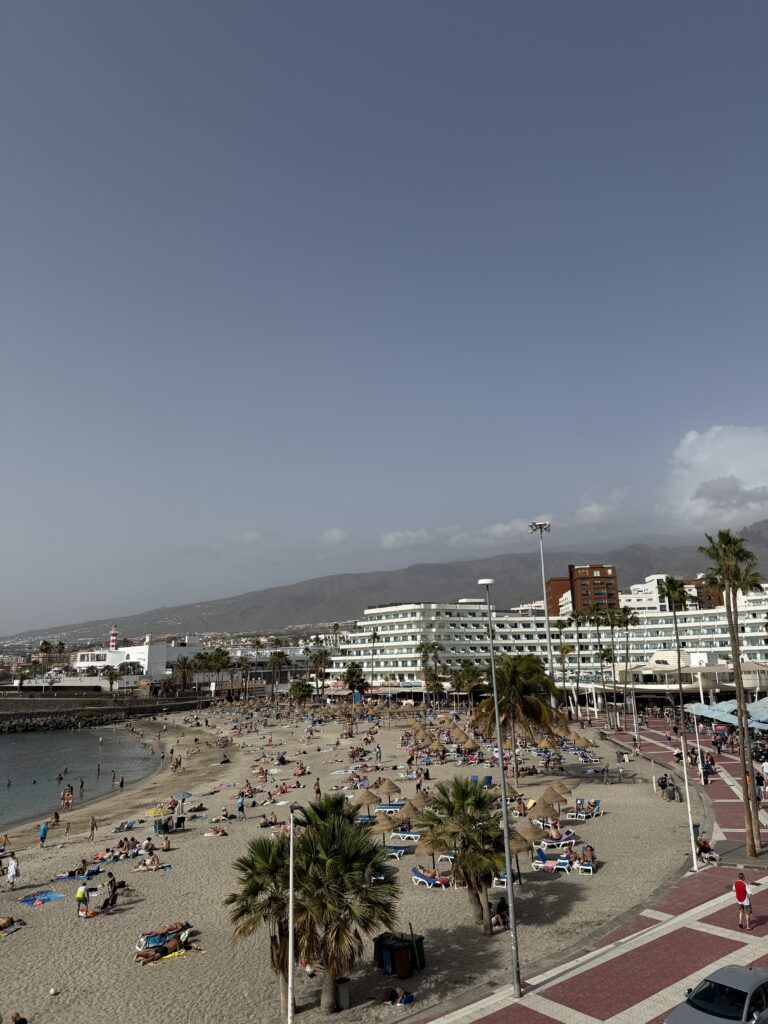
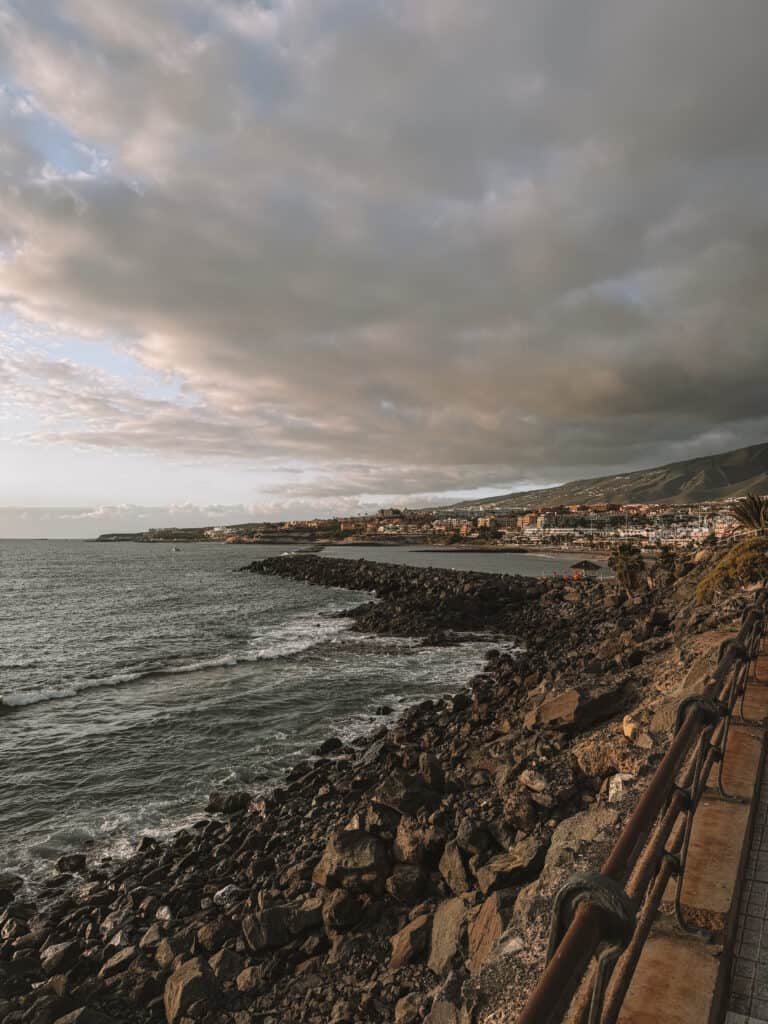
Here’s the thing about Costa Adeje: as an artificial resort town goes, it’s actually very pleasant. And for families with babies and toddlers, it works well in ways the hotel didn’t.
The promenade is long, flat, and almost entirely pram-friendly. Walking left from the hotel, we went for about fifty minutes before nearly reaching the Hard Rock Hotel end of the strip — passing beaches, restaurants, hotels, more restaurants, more hotels. Walking right takes about thirty minutes and is equally easy with only one point where stairs are the shortcut but a flat detour works fine.
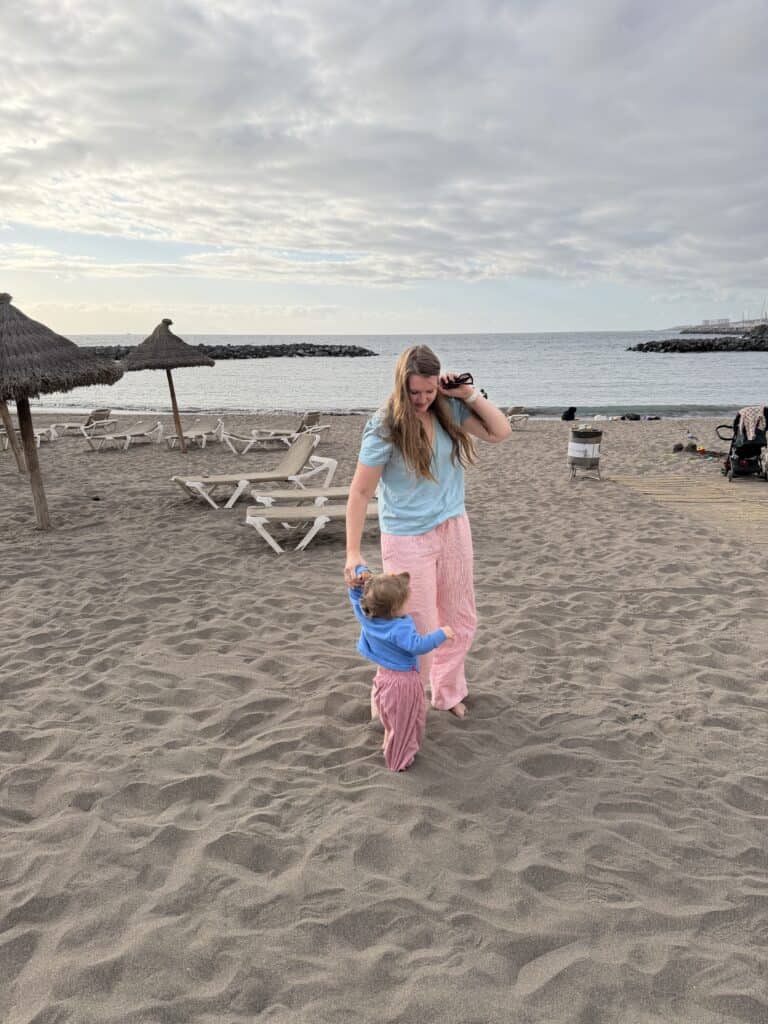
The beaches have dark volcanic sand which Mila absolutely loved. On any day with reasonable weather, she would play there for an hour without stopping — fully absorbed, completely happy. That beach time was genuinely the best part of the trip for her.
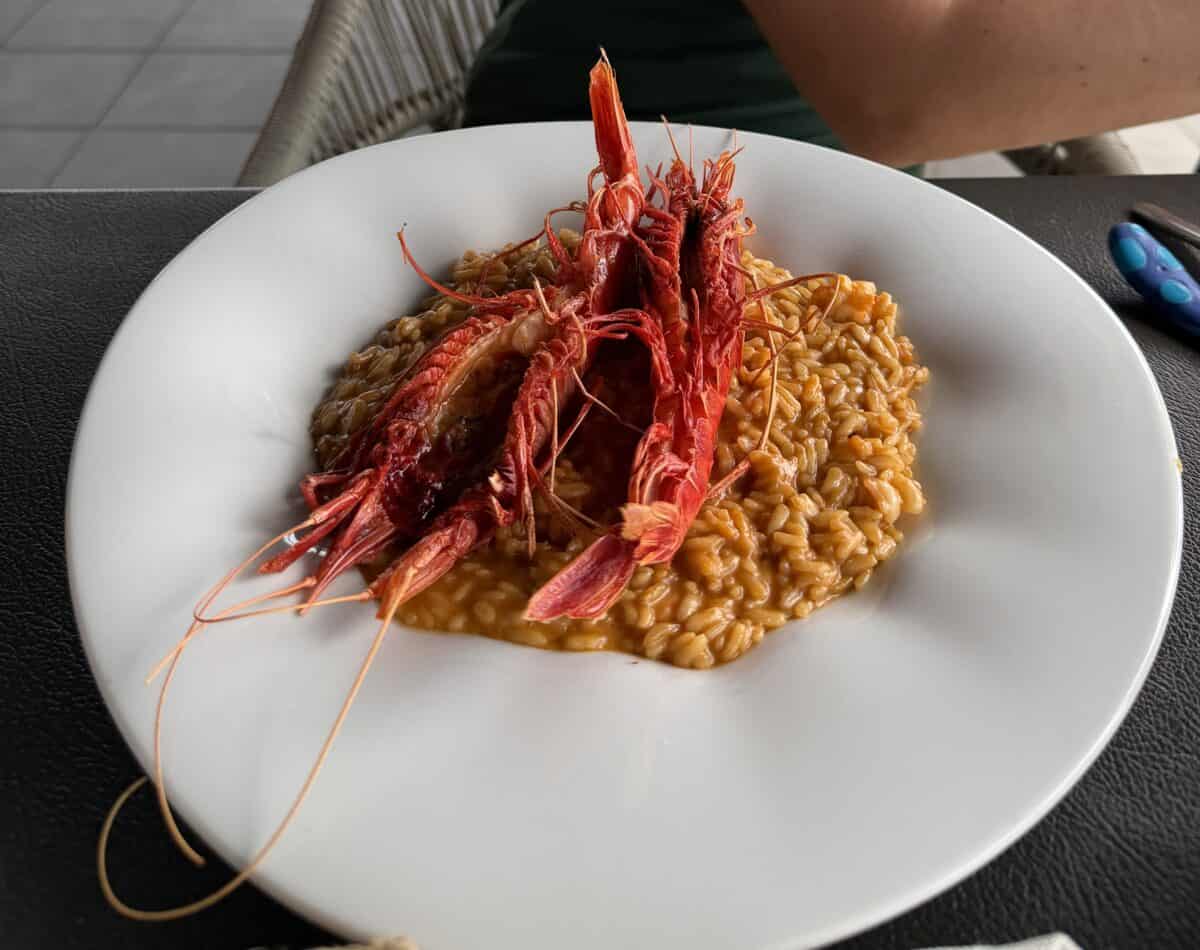
Restaurants throughout Costa Adeje were consistently welcoming — high chairs everywhere, staff patient and warm with babies, genuinely unfazed by the mess a fourteen-month-old generates over lunch. The only place we’d actively steer you away from is La Cena, right near the hotel — the only restaurant we’d rate 1 out of 5, and the only genuinely bad meal of the trip. Everything else ranged from good to excellent.
We also hired a car, which I’d recommend. It opened up the island considerably:
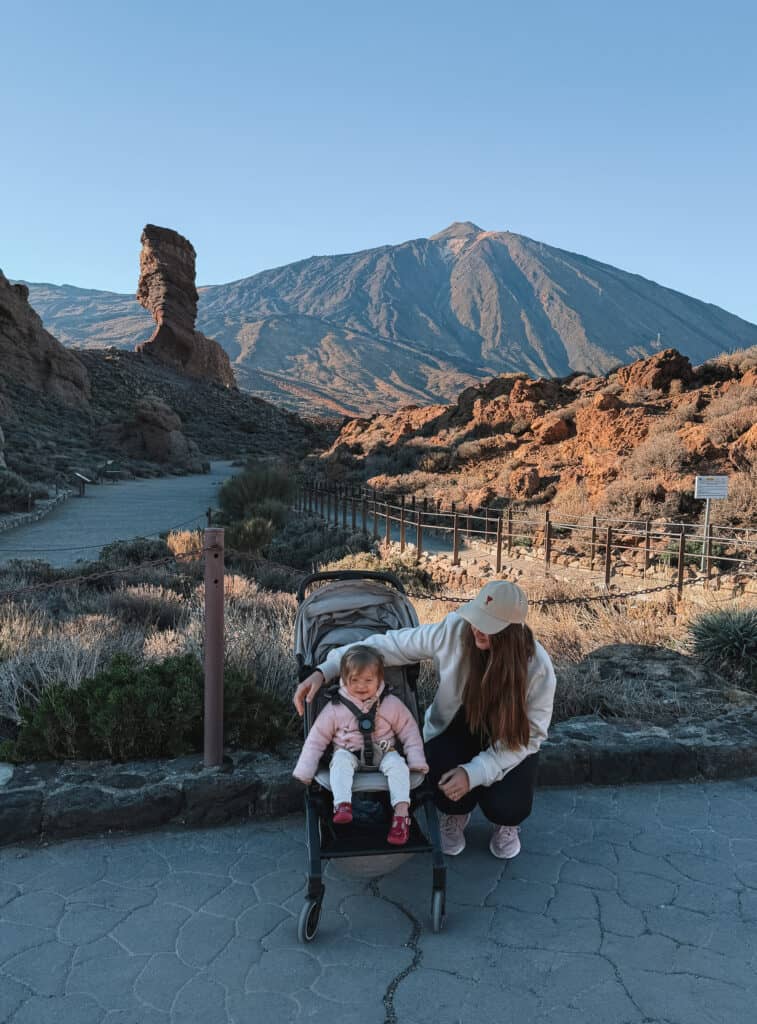
Teide National Park is about an hour’s drive and absolutely worth it. We didn’t hike — you can, with a baby carrier or Tula backpack, and we saw families doing it — but we didn’t need to. There are multiple viewpoints accessible with a pushchair, requiring only short walks of 200-300 metres. The landscape is unlike anywhere else in Europe. It genuinely feels like a different planet. We caught the golden hour and the light was extraordinary. Go.
Siam Mall is a good option for rainy or cold days — we went twice. There’s a decent pizzeria inside. It’s clean, easy to navigate with a pram, and a legitimate escape when the weather turns.
Siam Park — one of the best water parks in the world by most accounts — we skipped, because Mila isn’t old enough to enjoy it yet. Same with the remarkable bird zoo nearby, which is apparently exceptional. These are strong reasons to come back when she’s older.
Would I Recommend Dreams Tenerife with a Baby?
It depends almost entirely on the age of your child.
With a baby under ten months — pre-walking, content to sit, napping frequently — Dreams Tenerife Preferred Club would work well. The Bali beds are lovely, the breakfast lounge is excellent, the room is comfortable. The pool temperature and food quality are the main downsides, but a younger baby won’t care about either.
With a walking toddler of twelve months and above — it’s harder. The stairs, the lack of any toddler play space, the Bali beds that a mobile baby won’t stay on, the à la carte dinner situation, and the pool depth all combine to make the experience more effortful than restful. Not impossible — we still had genuinely lovely moments — but not the easy, relaxed holiday we’d hoped for.
If you do book Dreams Tenerife:
- Book Preferred Club — the lounge breakfast and the Bali bed area are worth it
- Book a suite or room with a separate living area if your baby needs darkness to sleep
- Bring the lightest pushchair you own — not your main pram
- Bring a baby monitor if your child is old enough to be left sleeping in the room
- Hire a car — the island rewards it
- Don’t go in March expecting guaranteed warmth — late April through October is safer
Would I Go Back to Tenerife?
Yes — but when Mila is older. At three, four, or five years old, Tenerife makes enormous sense: Teide, Siam Park, the bird zoo, the beaches, the hiking. It’s a genuinely great island for families with children who are past the toddler stage.
At fourteen months, we didn’t see the best of it. Costa Adeje is not the whole of Tenerife, and the weather didn’t help. But even through cold days and buffet dinners and a horrible return flight, there were moments — Mila playing in the dark volcanic sand, the golden light over Teide, a really excellent lunch on the promenade — that made it worthwhile.
We just know better now what we need. And we’ll plan accordingly next time.
Frequently Asked Questions
Is Dreams Tenerife good for babies? For pre-walking babies under ten to twelve months, yes — the Preferred Club setup is comfortable and the suite configuration works well for sleep-sensitive babies. For walking toddlers, the stairs, lack of toddler facilities, and pool depth make it more challenging than ideal.
Is the Preferred Club worth it at Dreams Tenerife? Yes, primarily for the Bali beds and the breakfast lounge. The lounge breakfast alone — freshly prepared to order, warm service, much calmer than the main buffet — justifies the upgrade. Arrive early for the Bali beds.
Is Costa Adeje good for families with babies? Yes. The promenade is long and flat, restaurants are consistently baby-friendly with high chairs and patient staff, and the beaches are lovely. Hire a car to make the most of the wider island.
What is the best time of year to visit Tenerife with a baby? Late April through October for the most reliable warmth. March can be beautiful but carries weather risk — we hit an unusual cold snap and had 15-16°C for most of our trip.
Is Teide National Park accessible with a pushchair? Some viewpoints are — we managed three with a pushchair, each requiring only 200-300 metres of flat walking. The hiking trails are not pushchair-friendly, but with a baby carrier or Tula backpack they’re doable. The views are extraordinary and worth the drive regardless.
How does travelling with a 14-month-old compare to younger ages? Significantly more challenging. A walking toddler who won’t sit still, won’t stay on a sun lounger, and needs dinner before overtiredness hits requires completely different logistics to a four or ten-month-old. Buffet dining becomes essential, a baby monitor for evenings is invaluable, and flight timing matters more than ever.
Tenerife wasn’t the trip we’d planned. The weather let us down, the hotel food was consistently disappointing, and the return flight was one of the more stressful parenting experiences of the past year. But Mila played in black sand for an hour every day she got the chance, we stood at the edge of a volcano at golden hour, and we had a dozen excellent lunches on a sunny promenade.
We’ll be back. Just with a three-year-old, a baby monitor, and a flight that lands before 9pm.
We’ve also written about travelling to Dubai with a ten-month-old, our Cullinan Belek (Turkey) review with a nine-month-old, and flying long haul with a three-month-old on British Airways — all linked above.

