


Can RFK Jr.’s new cooking show make Americans healthier?
This post isn’t about my political affiliation or my feelings towards RFK Jr. (I’m a Canadian, living in Canada). It’s about what I observed in the first two episodes of the Real Food Show, available now on YouTube.
Let’s put politics aside and acknowledge that we have the same hopes for our respective countries and for humans around the world: that people will be healthy and happy. Countries are stronger and more productive when people are healthy and happy, when they live in communities that support and nurture their inhabitants, and when they are overseen by governments that care.
Health Secretary RFK Jr. developed the Real Food Show to teach viewers how to create simple, nutritious meals on a budget of under $5 per serving. Each episode features Kennedy cooking a meal with a different chef from around the country, and the recipes are available on the HHS website.
In theory, a show like this is a good idea. In practice, I found it fatally flawed.
The first episode featured chef Andrew Gruel cooking salmon cakes with an arugula salad. The second episode starred chef Geoff Zakarian making a French omelette with a green salad of butter lettuce and herbs.
My first thought in both of these episodes was, where do you find arugula and French butter in a food desert?
But I digress.
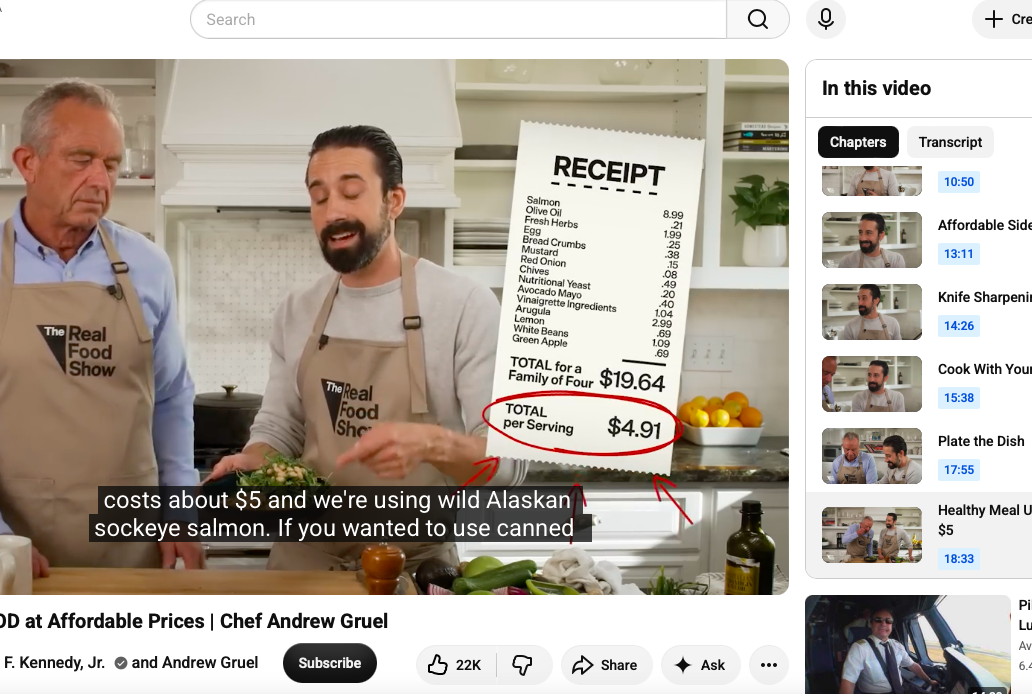
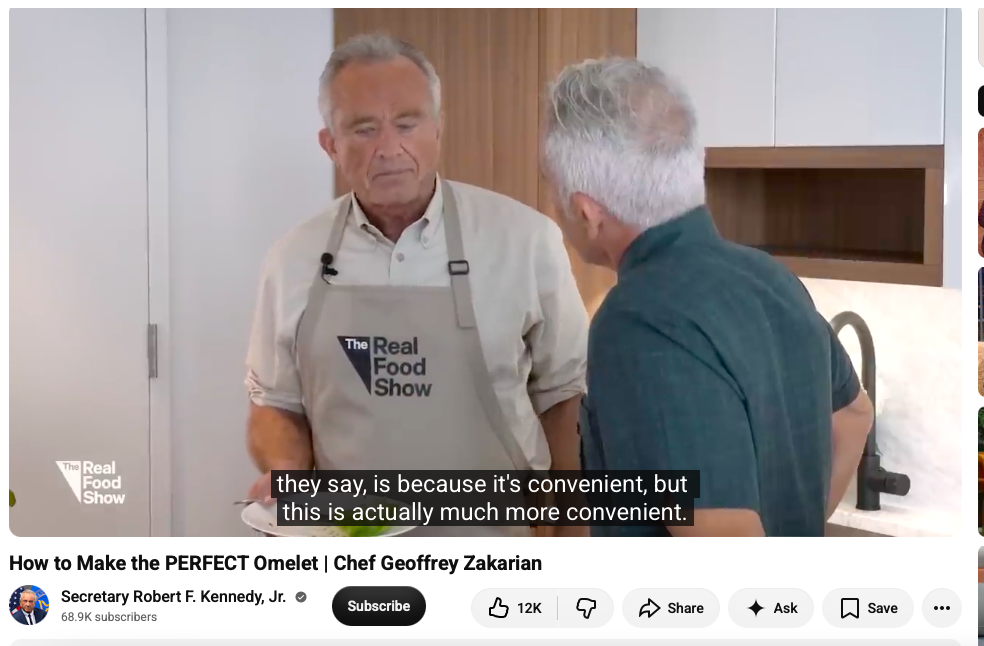
It didn’t take long to become painfully clear that both chefs have a complete lack of awareness around the actual cost of food. When Gruel offhandedly said in his episode that his meal takes only 20 minutes to make “because time is money,” it indicated (at least to me) who his intended audience really is. Similarly, Kennedy says cooking an omelette is “more convenient” than buying fast food, but for who?
The show gives viewers the prices of each ingredient as the recipe is made, but here’s the problem: they’re priced by single servings. While presenting numbers this way makes the recipes look cheaper, it doesn’t reflect the real-life cost of each ingredient. Nobody goes to the store and buys a tablespoon of avocado mayonnaise or one egg, and the cost of stocking a pantry with the recommended ingredients to make both these meals is far higher than stated. That’s especially true when some of these ingredients happen to be more expensive versions.
For example, Zakarian goes on for what seems like forever about how amazing French butter is compared to regular butter, and how French butter is “real butter.” This sounds a lot like he’s suggesting that regular butter isn’t “real.” He tells viewers that French butter is “a bit more expensive,” and he’s right: per serving, French butter costs $0.80, while regular butter is $0.20. While both chefs give cheaper alternatives for some of the ingredients in the recipes, their narratives portray those alternatives as sub-par.
Are we helping people make affordable recipes, or are we trying to scare them into buying costlier ingredients?
But we’re just getting started here.
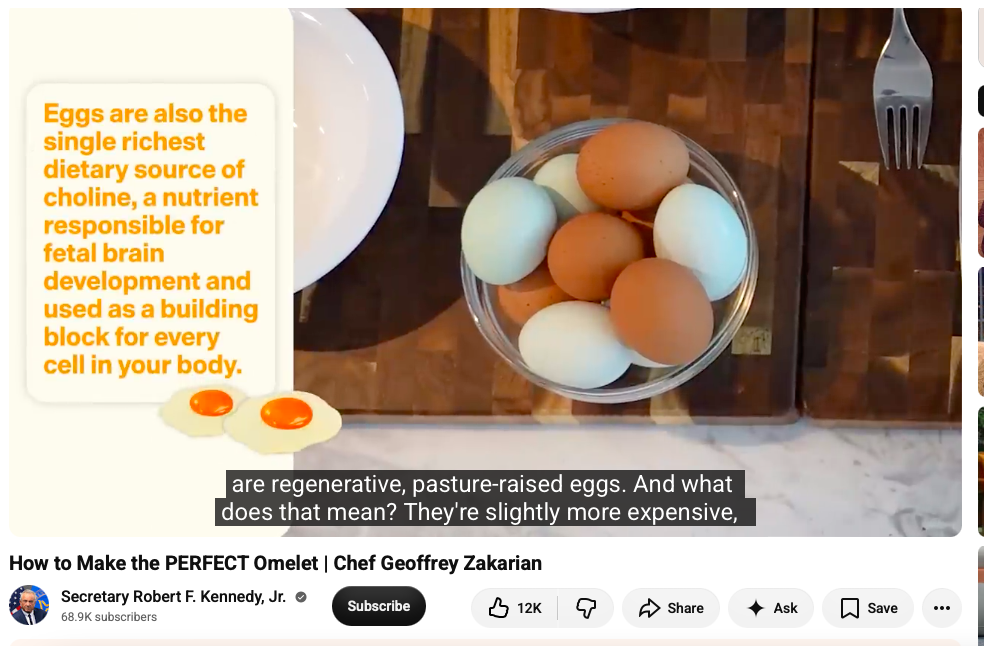
Zakarian is also a huge fan of regenerative, pasture-raised eggs, which are eggs from chickens that are allowed to run around outside and eat dirt and bugs and grass. They’re also far more expensive than regular eggs. According to my research, you’ll pay between $6 and $9.50 for 12 eggs, while regular eggs can be had for around $1.70 a dozen. (All prices are in USD).
When he cooks the omelette recipe on the show, he uses 2 whole eggs plus one yolk. The same recipe for 4 on the HHS website uses THE ENTIRE DOZEN EGGS. That’s right – 4 servings use all 12 eggs, and you’re throwing 4 of those egg whites out because the recipe calls for more yolks than whole eggs.
Let them eat cake!
The salmon cakes that Gruel makes are similar in terms of pricing. Again, we have some costlier ingredient options – he suggests using avocado oil ($17.37 per bottle) and avocado oil mayonnaise ($4.22 for 12oz vs regular mayo at $2.18 for 15oz) to avoid seed oils (more on that in a bit). And while Gruel does say the cakes can be made with any type of fish including canned salmon, he makes the recipe with frozen wild alaskan sockeye filets, which he says are $8.99 for 4 servings.
I couldn’t find 12oz (4x 3oz servings) of wild alaskan salmon in a large U.S. store for less than $12.96, but even that fish was of unknown origin, which goes against Gruel’s “American only” rule for seafood.
He also recommends using organic canned white beans in the accompanying salad. Organic food is not any healthier or safer than conventional food, and in most cases, it costs more.
I could go on and on about ingredients, but let’s lay out the final costs as per the videos:
Salmon cakes and arugula salad: $19.64 for 4 servings. One media outlet said that stocking up on all of the ingredients for this recipe cost them $98. (Citation)
French omelette with green salad: $12.60 for 4 servings.
Now, it’s time for a reality check.
A recent poll found that 51% of Americans struggle to afford groceries. (Citation). Depending on which source you use, around 35 million Americans live at or below the poverty line, which for 2026 is $33,000.
Using the USDA Thrifty Food Plan, a low-cost, nutritionally adequate diet comes out to around $1000 a month for groceries for a family of four.
Here’s how that breaks down:
$33 a day for the family, $11 per family meal, and $2.75 per person per meal. This is BARE BONES, not necessarily what a family living in poverty actually has available. Even the USDA’s lowest-cost food plan works out to around $3 per person per meal.
While the omelette may come close to this if you use regular eggs, the salmon cakes are in another universe.
Then, there’s the misinformation.
Besides the financial bait and switch, I was astounded by the amount of misinformation and partisan language delivered by both RFK Jr. and both chefs. Here are a few examples:
RFK Jr. talked about how the Biden administration put Froot Loops at the top of the food pyramid, a claim that’s obviously false. He also implied that the science that was used by previous administrations to develop the guidelines, ‘wasn’t real.’ It’s interesting how RFK Jr.’s sudden interest in ‘real science’ doesn’t align with his recent approval of untested, unproven, unregulated peptides by a panel he stacked with peptide producers and salespeople.
Kennedy also claimed that because our seafood intake is so low, we have deficiencies in omega-3 fats, DHAs (same thing as omega-3, his mistake not mine), selenium, zinc, and iron. Nonsense. A lower than recommended intake does not automatically equal a nutritional deficiency. This sort of rhetoric is untrue, it scares people, and it also drives sales of unnecessary supplements.
Kennedy also said that because of its high seafood consumption, Japan has ‘no metabolic disease.’ This is absurd.
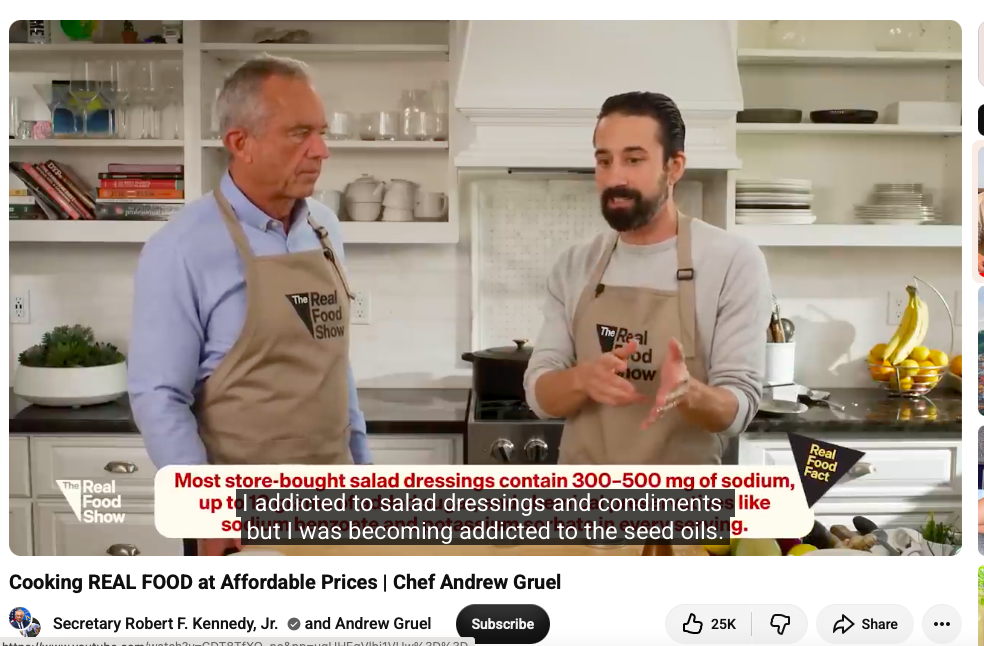
And of course, there was a lot of anti-seed oil blather by both chefs and RFK Jr., including Gruel saying that he was “addicted” to seed oils and that he healed his G.I. issues by cutting them out. Seed oils are associated with positive or neutral health outcomes, and they are not addictive. The throwing around of words like “addictive” only serves to minimize the struggles of individuals who truly have an addiction.
The bottom line is this:
We eat too many ultra-processed foods, and not enough fiber, fruits, and vegetables. Only 10% of Americans get enough fruits and vegetables. Only around 7% of Americans get the recommended 21-34 grams of fibre a day. (PMID: 30202317), (PMCID: PMC8181294)
Many people lack the confidence and skills in the kitchen to produce even a simple meal.
The rates of chronic disease in the U.S. are steadily rising, and while diet is a part of that, so are other factors. (PMID: 40245168)
I see these circumstances as symptoms of complex issues that can’t be solved with a simple “eat this, not that, and watch how I make my vinaigrette! Time is money!”
Can teaching people basic cooking skills help? Of course. And this is where the Real Food Show is on the mark.
But when peoples’ access to fresh, whole foods is limited geographically, financially, or otherwise, and basic nutrition education at school is nonexistent, and healthcare is so expensive that people would rather not go to the doctor than pay for the care they need, THESE THINGS ARE THE ACTUAL PROBLEM. (PMID: 38160801), (PMID: 40612083), (PMID: 39441597)
We can talk for years about how the artificial colours in Froot Loops are allegedly causing people to become ill, or we can actually focus on making changes that will truly help the state of health in the U.S. and beyond.
These are: improving health equity and access to healthcare, establishing safety nets like food assistance, community supports, and social programs, lowering the price of food and eliminating food deserts, making housing and gas more affordable, and having mandatory nutrition education in schools.
A show that pushes French butter and expensive eggs as a fix to the country’s health crises, speaks only to the 1%, not to the people who actually need help. We need less performance, and more action on the systemic issues that are intimately linked to the rising rates of chronic disease.

