


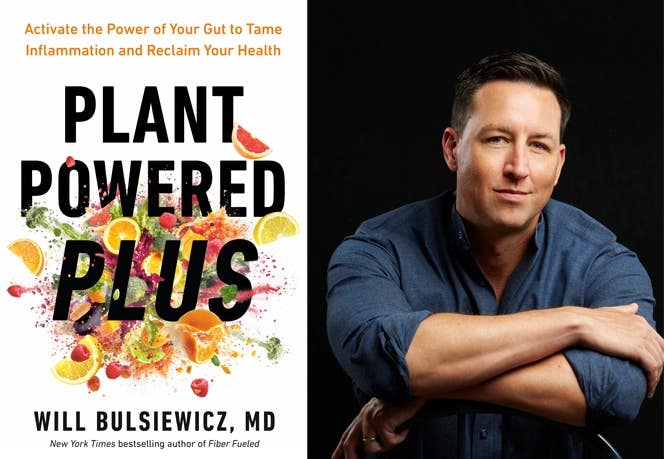
Longtime Forks Over Knives friend Will Bulsiewicz, M.D.—aka the “Gut Whisperer”—is back with a new book, Plant-Powered Plus, out January 13. In the new book, the gastroenterologist and bestselling author takes a clear, evidence-based look at common questions and misconceptions surrounding gut health and plant-based eating. In the abridged excerpt below, he examines one such claim. Learn more about Plant-Powered Plus here.
For the last 20 years, we’ve been given reason after reason to avoid beans and whole grains: They’re not ancestral; they have anti-nutrients like phytates; lectins are the cause of our health issues; gluten causes leaky gut. The result? We’ve been avoiding them. The average American eats just two ounces of beans per week while consuming nine times that amount in added sugar. And while 95% of Americans are deficient in fiber, 98% of Americans are deficient in whole grains. Is our avoidance justified? Or are we being fed misinformation that’s actually harming us in our food choices? My vote is for the latter. Here’s why.
First, beans and whole grains are jam-packed with prebiotic goodness. They’re about as high in fiber as you’ll find. They also deliver resistant starch. And they can be a source of a third type of prebiotics, which we are about to discuss, called polyphenols. These prebiotics work together in a synergistic fashion to support the microbiome and shift it back to health.
Second, the proof is in the research. We can keep this super simple—it doesn’t need to be complicated. Do beans cause inflammation? Quite the opposite. Multiple randomized controlled trials (RCTs) show that beans reduce inflammation in humans. How about whole grains? More of the same. We have literally a dozen RCTs showing less inflammation when you consume more whole grains.
Simply put, these are not inflammatory foods. That said, it’s possible that our modern agricultural practices may explain the reports out there of people developing inflammatory health issues. Both beans and whole grains are often sprayed with glyphosate after harvest because something you use to kill weeds can also be used to dry out beans and whole grains. This is why I personally opt for organic. I prefer my plants glyphosate-free. I prefer to not ingest weed killer.
Some individuals have celiac disease—an autoimmune condition where gluten triggers an immune response. If you experience symptoms when consuming gluten-containing grains, it’s important to get tested. Common tests include a blood test for tissue transglutaminase (tTG) lgA antibodies, an intestinal biopsy via endoscopy, and genetic testing for HLA-DQ2 and HLA-DQ8. Additional assessments, like lgG and lgA anti-gliadin antibody tests, can indicate gluten sensitivity. If any of these tests are positive, adopting a gluten-free diet makes sense. Even if tests are negative but symptoms persist—especially if you have an autoimmune or chronic inflammatory condition—it may be worth trying a gluten-free diet to see if you feel better. However, a gluten-free diet isn’t universally necessary or beneficial. In fact, research suggests that eliminating gluten-containing whole grains can increase the risk of heart disease and diabetes, so it’s crucial to weigh the benefits and drawbacks before making broad dietary changes.
To summarize my thoughts on the complex topic of gluten: First, if you are experiencing symptoms related to gluten, you should be tested for celiac disease. If your test is negative, know the evidence that gluten alone triggers the immune system in non-celiac individuals is weak—mostly supported by lab studies without solid human evidence. Additionally, non-gluten components of wheat, barley, and rye called fructans are known to cause digestive symptoms. This could be why many people feel better when eating sourdough bread, which naturally reduces fructan content. If you decide to go gluten-free, focus on incorporating gluten-free whole grains—such as quinoa, sorghum, teff, amaranth, buckwheat, and rice—to ensure you have a nutritious and balanced diet.
At their core, beans and whole grains are microbiome foods. More than most other plant-based foods, they powerfully feed and fuel your microbiome with fiber, resistant starch, and polyphenols. What that also means is that if you have a damaged gut, you are highly likely to struggle to digest them because these nutrients require your gut microbes in order to be digested. The result is that you might experience bloating, gas, and generally feel unwell. But bloating is not inflammation. It’s sloppy digestion. Your gut is struggling to keep up with the volume of prebiotics. The solution to this is to ease into these foods. Start low, and go slow.
Photo of Will Bulsiewicz by Drew Somerville
Text adapted from PLANT POWERED PLUS by arrangement with Avery, a member of Penguin Group (USA) LLC, A Penguin Random House Company. Copyright © 2026, Will Bulsiewicz, MD.

