


Yoga is no longer limited to studios, retreats, or spiritual communities. Today, it is practised in homes, schools, offices, hospitals, and community centres across the world. For many people, yoga is not a trend or a fitness challenge it is a practical way to manage stress, stay mobile, and support mental well-being.
As modern lifestyles become more sedentary and mentally demanding, yoga has quietly moved into everyday routines. People turn to it not for performance or competition, but for balance, consistency, and long-term health.
Looking at yoga statistics helps us understand how deeply this practice has entered daily life. Numbers alone do not explain yoga’s value, but they do show how widely people rely on it. When a practice continues to grow and then stabilise across decades, it often signals lasting relevance rather than short-term popularity.
By 2026, yoga is practised in nearly every country and across all age groups. Its steady growth reflects broader shifts in how people approach health moving away from treatment alone and toward prevention, mobility, and mental well-being.
This article looks at yoga statistics for 2026 with a clear focus on:
- How many people practise yoga worldwide
- Where yoga is most commonly practised
- How the global yoga ecosystem continues to grow
The aim is to present realistic, grounded data without exaggeration and explain what these numbers mean in everyday life.
About the data used in this article
Because yoga is often practised informally at home, in community spaces, or through online platforms, exact global counts are not possible. Unlike organised sports or gym memberships, yoga participation is rarely tracked through a single system.
For this reason, the figures shared in this article should be understood as informed estimates, not fixed totals.
The data used here draws from:
- Global wellness and fitness industry reports published between 2023 and 2025
- National health and lifestyle surveys
- Government-linked yoga and wellness initiatives
- Market research on digital and hybrid wellness platforms
All figures are presented as ranges, a method commonly used in public health research when behaviour is self-reported or informally practised. This approach provides a more accurate picture than single, absolute numbers.
Yoga statistics at a glance (2026)
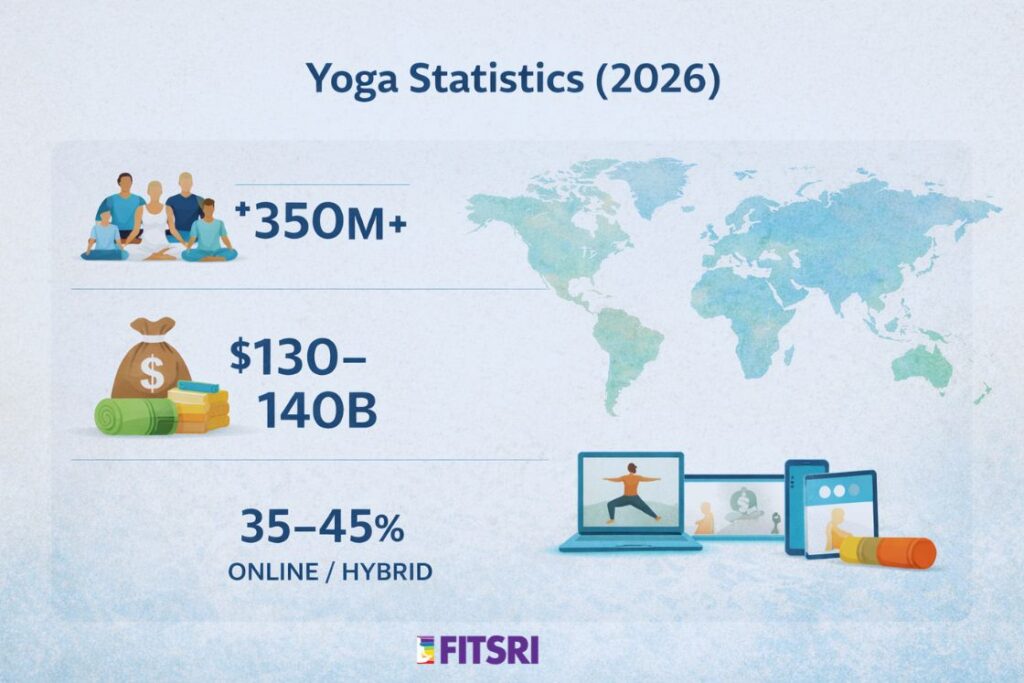
- Estimated global yoga practitioners: 300–350 million
- Countries where yoga is practised: 190+
- Estimated global yoga market size: USD 130–140 billion
- People using online or hybrid yoga formats: Approximately 35–45%
- Overall participation trend: Stable, long-term growth
These figures describe scale and direction, not exact headcounts. They show how yoga has moved from a niche or specialist practice to a widely adopted part of modern health behaviour.
The combination of widespread participation, geographic reach, and steady adoption suggests that yoga has moved beyond trend cycles and into long-term use.
Also Read: International Yoga Festival 2026
How popular is yoga worldwide in 2026?
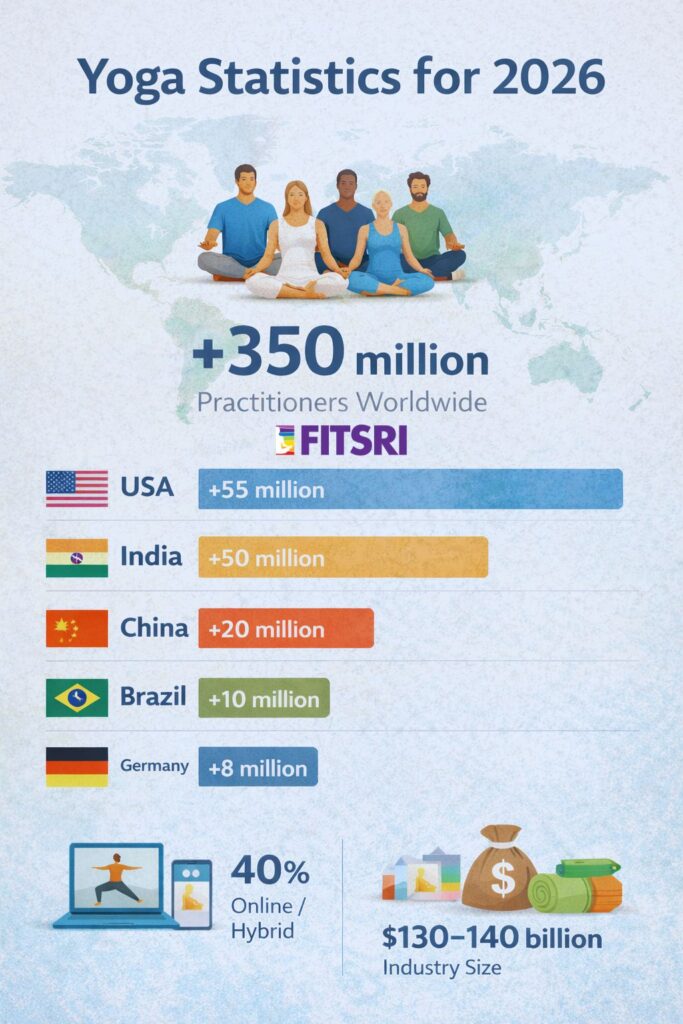
Yoga is now one of the most widely practised wellness activities in the world. By 2026, an estimated 300 to 350 million people practise yoga in some form. This includes people who attend regular classes, practise occasionally, or follow yoga routines at home without formal instruction.
What stands out is not only the size of this number, but the pattern behind it. Global participation in yoga grew rapidly from the early 2000s through the late 2010s. After 2020, that pace slowed—but it did not reverse. Instead, yoga entered a phase of stable, long-term use.
This matters because many fitness trends follow a boom-and-bust cycle. Yoga has followed a different path one shaped by consistent demand across decades rather than short-lived enthusiasm.
Who practises yoga today?
Yoga participation spans a wide range of ages, lifestyles, and backgrounds. While patterns vary by country, several consistent trends appear across national health surveys.
- Adults aged 25–55 form the largest group of regular practitioners, often using yoga to manage work-related stress and physical strain
- Older adults increasingly practise yoga to support mobility, balance, and joint health
- Younger adults and students often turn to yoga for stress relief, focus, and mental well-being
- Many beginners start yoga at home using online videos or apps rather than studios
Surveys also show that yoga attracts people who may feel excluded by high-impact or competitive fitness environments. This includes individuals with sedentary jobs, chronic stress, or physical limitations.-impact fitness routines. This includes individuals with sedentary jobs, chronic stress, or limited access to gyms.
Why people continue to practise yoga
Health and lifestyle surveys consistently show that people stay with yoga for practical reasons, not trends or identity. The most commonly reported motivations include:
- Managing stress and anxiety
- Improving flexibility and posture
- Supporting back, joint, and mobility health
- Creating a regular routine for mental calm and focus
Yoga’s adaptability plays a key role in this continued engagement. It can be practised gently or dynamically, in short sessions or longer routines, alone or in groups. This flexibility allows people to adjust their practice as their bodies, schedules, and needs change over time.
Rather than replacing other forms of activity, yoga often complements walking, strength training, or rehabilitation exercises.d. This flexibility allows people to practise yoga at different life stages without needing to “outgrow” it.
Yoga as a long-term health habit
By 2026, yoga is no longer widely viewed as an alternative or niche activity. In many countries, it is increasingly recognised as a supportive health habit, similar to walking, stretching, or mindfulness practices.
This shift helps explain why yoga participation has remained stable even as fitness trends change. Yoga addresses needs that do not disappear with time movement, breathing, body awareness, and mental steadiness.
As health systems and public institutions place greater emphasis on prevention and self-care, yoga continues to fit naturally into everyday routines rather than standing apart from them.
Where yoga is practised around the world
Yoga is practised globally, but participation levels and styles vary by region. These differences are shaped by cultural familiarity, access to instruction, urbanisation, and attitudes toward preventive health.
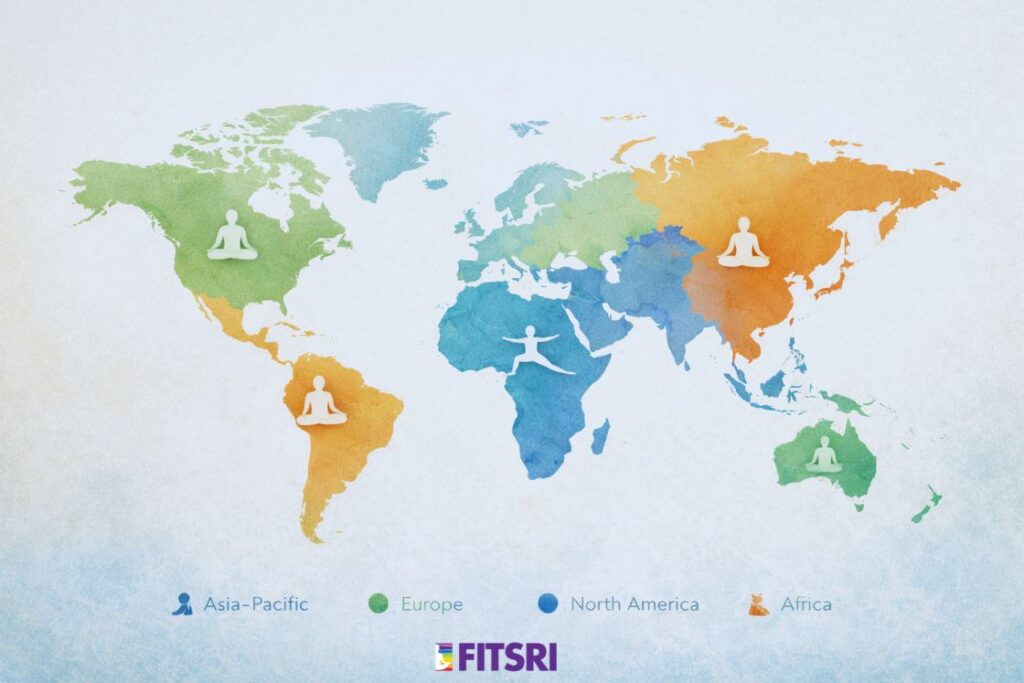
By 2026, yoga is practised in more than 190 countries, making it one of the most geographically widespread wellness practices in the world. However, its role and presentation differ from place to place.
Asia-Pacific: cultural roots and modern expansion
The Asia-Pacific region accounts for the largest absolute number of yoga practitioners. South Asia remains the cultural and historical centre of yoga, where the practice is taught through traditional lineages as well as modern institutions.
In countries such as India, yoga is practised:
- In homes and community spaces
- In schools and universities
- Through government-supported wellness programmes
Alongside this long-standing presence, yoga has expanded rapidly in urban centres across East and Southeast Asia. In these settings, yoga is commonly adopted as a stress-management and lifestyle practice, particularly among working professionals.
The combination of cultural continuity and modern health needs explains the region’s strong participation.
North America: high participation and commercial integration
North America shows high per-capita participation and one of the most developed yoga industries. Yoga is integrated into everyday life through:
- Fitness clubs and studios
- Schools and universities
- Corporate wellness programmes
- Healthcare and rehabilitation settings
Public health data shows that many practitioners in this region use yoga to manage stress, back pain, and the effects of sedentary work. The wide availability of trained instructors and online platforms has also made yoga more accessible beyond major cities.
By 2026, yoga in North America is less about novelty and more about routine, preventive use..
Europe: focus on balance and well-being
AAcross Europe, yoga is well established and steadily practised. Participation is strongest in urban and semi-urban areas, where yoga is often associated with:
- Work–life balance
- Mental health support
- Preventive physical care
European yoga practice frequently places greater emphasis on gentler movement, breath awareness, and relaxation alongside physical postures. Growing public awareness of stress-related health concerns has supported yoga’s continued use across different age groups.
Latin America, the middle east, and africa: emerging but growing
In Latin America, the Middle East, and parts of Africa, yoga represents an emerging wellness practice. Growth is most visible in large cities and urban centres, driven by:
- Increased internet access
- Exposure to global wellness culture
- Rising awareness of stress and lifestyle-related health issues
In many of these regions, online classes and mobile platforms serve as the primary introduction to yoga. This digital-first access has helped reduce geographic and economic barriers to participation.barriers.
Urban and rural participation: closing the access gap
Globally, yoga participation remains higher in urban and semi-urban areas, where studios, instructors, and wellness programmes are more readily available. However, online learning has significantly narrowed this gap.
By 2026, digital access allows people in smaller towns and rural areas to practise yoga without relying on physical studios. This shift has played a meaningful role in yoga’s continued global spread and inclusivity.
Also Read: International Yoga Day 2026
How many countries practise yoga
By 2026, yoga is practised in more than 190 countries. This figure is often repeated, but it needs context to be properly understood. Yoga’s presence in a country does not always mean that it is widely practised or formally organised. Instead, it reflects varying levels of access, awareness, and adoption.
In some countries, yoga is part of everyday culture and public life. In others, it exists mainly through private studios, gyms, or online platforms. What matters most is not just the number of countries involved, but how yoga is used within those societies.
What “practised” means in global terms
At a global level, yoga is considered practised in a country when it is accessible through one or more of the following ways:
- Taught in studios, fitness centres, or community spaces
- Included in school, workplace, or public wellness programmes
- Available through online classes, apps, or digital platforms
- Practised informally at home using books, videos, or guided content
Even limited access is meaningful, because yoga often begins as a personal or home-based activity rather than a formally organised one. This is one reason yoga participation is difficult to measure precisely using traditional tracking systems.
Variation in yoga practice styles worldwide
Yoga does not look the same everywhere. Teaching styles, intensity, and emphasis vary depending on cultural context, lifestyle patterns, and health priorities.
For example:
- Some regions place greater emphasis on physical postures and mobility
- Others focus more on breathwork, relaxation, or stress management
- In certain cultures, yoga retains philosophical or traditional elements
- In others, it is framed primarily as a health-support or exercise practice
Despite these differences, the core elements of yoga remain consistent across regions: movement, breathing, and mindful awareness.
This flexibility helps explain yoga’s ability to adapt without losing its purpose.
Why global reach matters
Yoga’s presence across so many countries highlights its ability to cross cultural, linguistic, and social boundaries. Few wellness practices have spread so widely while remaining adaptable to local needs.
This global reach also explains why yoga statistics are best understood as estimates rather than exact figures. Unlike organised sports or regulated fitness programmes, yoga often exists outside formal institutions.
By 2026, yoga’s worldwide footprint reflects usefulness rather than promotion. It continues to spread not because it is pushed through campaigns alone, but because people find it practical and sustainable in daily life.
The size of the global yoga industry in 2026
As yoga participation has expanded worldwide, a broad global industry has developed around it. By 2026, the global yoga market is estimated to be worth between USD 130 and 140 billion. This figure reflects total spending across a wide ecosystem, not just studio classes or memberships.
It is important to understand that the yoga industry is not a single, uniform market. Instead, it includes education, services, products, and digital platforms that support how people practise yoga in everyday life.
The industry’s size reflects yoga’s long-term integration into health and wellness habits rather than short-term commercial trends.
What the global yoga industry includes
The yoga economy spans multiple interconnected segments, each supporting different ways people access and practise yoga. These include:
- In-person yoga classes and studio memberships
- Online classes, streaming platforms, and mobile apps
- Teacher training programmes and professional education
- Yoga apparel, mats, and practice accessories
- Retreats, workshops, and wellness travel
No single segment dominates the industry entirely. This diversity has helped yoga remain resilient during economic changes, as participation does not depend on one format or delivery model. is one reason the yoga industry has remained resilient even during periods of economic uncertainty.
In-Person and digital yoga: A blended model
Before 2020, in-person classes and studio memberships accounted for most yoga-related spending. After 2020, digital and hybrid formats expanded rapidly due to changes in work patterns, mobility, and access.
By 2026:
- Around 35–45% of practitioners use online or hybrid yoga formats
- Many people combine home practice with occasional in-person sessions
- Digital access has become a permanent part of how yoga is learned and maintained
Rather than replacing studios, online platforms have extended yoga’s reach especially for people with limited time, physical constraints, or geographic barriers. expanded yoga’s reach-especially for people with limited time, mobility, or geographic access.
Why the yoga industry shows long-term stability
Unlike trend-driven fitness sectors, the yoga industry shows steady, long-term growth rather than sharp rises and sudden declines. Several factors help explain this stability:
- Yoga requires minimal equipment and space
- Practitioners often remain engaged over many years
- Teaching adapts easily to different ages, abilities, and settings
- Demand is driven by ongoing health needs, not novelty
This stability suggests that yoga’s economic presence is closely linked to its practical value rather than marketing cycles.
Commercial growth without losing accessibility
While yoga has become a significant global industry, it remains widely accessible outside commercial systems. Millions of people practise yoga without paid memberships, branded products, or formal instruction.
This balance between structured industry growth and informal personal practice is unusual in the wellness sector. It helps explain why yoga continues to grow without becoming exclusive or dependent on high-cost participation.
Yoga’s accessibility remains one of its defining strengths.
How yoga has changed over time
Yoga has not remained fixed as it spread across different cultures and regions. Its teaching methods, entry points, and public understanding have evolved in response to changing lifestyles, work patterns, and health needs. At the same time, its core purpose has remained largely unchanged.
Understanding this evolution helps explain why yoga continues to be widely practised in 2026.
From traditional systems to modern practice
Traditionally, yoga was taught as a comprehensive system that included physical discipline, breathing practices, mental training, and ethical principles. Learning often took place over long periods, under close guidance, and within specific cultural contexts.
As yoga moved beyond its regions of origin, it adapted to new environments. In many countries, yoga was first introduced through physical postures because these were easier to teach in group settings and aligned more closely with existing fitness cultures.
This shift made yoga more accessible to a wider population, even as it changed how the practice was introduced and understood.
Physical practice as the common entry point
By the late 20th and early 21st centuries, posture-based yoga had become the most common entry point worldwide. For many people, yoga was introduced as a way to improve flexibility, posture, and general physical fitness.
Participation data and health surveys suggest a consistent pattern:
- Most beginners start yoga for physical reasons
- Breathwork and relaxation practices are often added later
- Long-term practitioners tend to expand their practice gradually
This progression reflects how people engage with yoga over time starting with visible, practical benefits before exploring other aspects..
Secular and inclusive teaching approaches
Another significant change has been the secular framing of yoga in many regions. Teaching is often presented using health-focused language rather than religious or philosophical terms. This has made yoga more accessible to people from diverse cultural and religious backgrounds.
This approach has:
- Increased participation across different age groups
- Allowed yoga to be included in schools and workplaces
- Reduced barriers for people new to the practice
At the same time, traditional teachings continue to exist alongside modern formats, offering depth for those who wish to explore yoga more fully.
Continuity beneath change
Despite changes in presentation and delivery, yoga’s central aim has remained consistent: supporting balance in the body and steadiness in the mind.
By 2026, yoga’s ability to adapt without losing its function helps explain its long-term survival. Practices that remain useful tend to evolve, and yoga has done so in a way that allows it to remain relevant across cultures and generations.
What the future of yoga looks like beyond 2026
By 2026, yoga is no longer in a phase of rapid expansion. Instead, it has entered a period of steady integration into everyday health and wellness systems. This stage is often more meaningful than rapid growth, as it signals long-term usefulness rather than short-term popularity.
Rather than asking whether yoga will continue to grow, the more relevant question is how yoga will be used in daily life, public health, and community settings.
Deeper integration Into health, education, and workplaces
One clear direction is yoga’s increasing presence within structured environments. Across different regions, yoga is gradually being included in:
- School and university wellness programmes
- Workplace stress-management initiatives
- Community health and rehabilitation settings
This integration reflects growing recognition of yoga as a supportive health practice. It is not positioned as a replacement for medical care, but as a complementary approach that supports movement, stress management, and overall well-being.
Greater emphasis on safety and personalised practice
As yoga reaches broader populations, there is increasing attention on safe and appropriate practice. This includes:
- Modified postures for different age groups and abilities
- Clear guidance for beginners and older adults
- Greater awareness of individual physical limitations
Future growth is likely to focus less on expanding numbers and more on how yoga is taught and adapted to individual needs.
Digital and hybrid yoga as a permanent model
Digital yoga platforms are expected to remain a stable part of the yoga landscape. Rather than replacing in-person learning, online access supports consistency and flexibility.
Hybrid models combining digital access with occasional in-person instruction are becoming the norm for many practitioners. This approach allows yoga to fit more easily into varied schedules, locations, and physical needs.
Stability over trend cycles
Many wellness trends rise quickly and fade just as fast. Yoga’s current trajectory suggests something different. Its continued presence is tied to ongoing human needs movement, breath awareness, and mental steadiness.
By 2026 and beyond, yoga appears positioned not as a trend to follow, but as a practice people return to repeatedly, across different stages of life.
Conclusion
Yoga’s global presence in 2026 reflects more than popularity. It reflects usefulness. Practised by hundreds of millions of people across more than 190 countries, yoga has become part of how modern societies approach health, balance, and well-being.
Its growth has stabilised, its forms have adapted, and its purpose has endured. In a world shaped by constant change, yoga’s ability to remain relevant without constant reinvention may be its strongest indicator of longevity.

