


Every woman who undergoes menopause goes through the same reduction in estrogen and progesterone production. But not every woman experiences menopause the same way. Some women seem to get off easy, and some women have a horrible experience. Have you ever wondered why?
Gut health may be part of the puzzle. Our understanding of the gut microbiome’s influence on hot flashes, mood swings, bone loss, and cardiovascular risk remains emerging. And the heart of this connection is a fascinating piece of your biology called the estrobolome.
What Is the Estrobolome, and Why Does It Matter After 40?
Your gut is home to trillions of microorganisms, bacteria, fungi, and other microbes, which together we call the gut microbiome. Within that diverse community is a specialized subset of bacteria that secretes an enzyme called beta-glucuronidase. These bacteria and their estrogen-metabolizing genes are collectively called the estrobolome.
Your gut can actually recycle estrogen. Here’s how it works:
Your liver packages used estrogen into an inactive, conjugated form and then sends it to your gut with bile. Most of it is eliminated in the stool. However, the secreted beta-glucuronidase enzyme from the estrobolome deconjugates some of the estrogen, allowing it to be reabsorbed from the gut back into circulation.
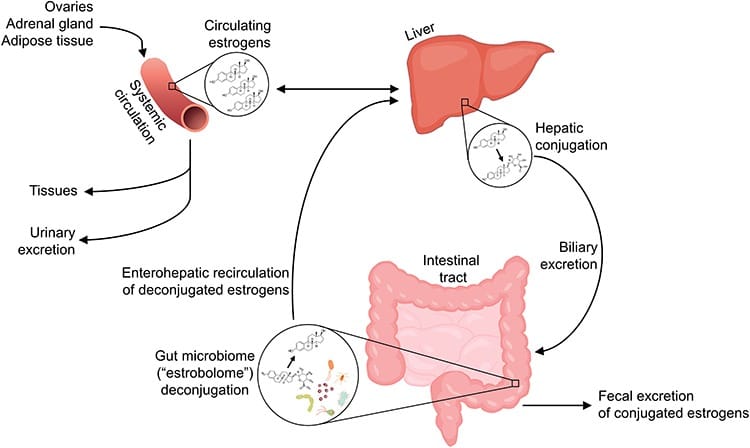
Estrobolome: How Gut Bacteria Recycle Estrogens, from Peters, et al 2022 (2).
When the estrobolome is surrounded by a diverse gut microbiome, it helps maintain the right level of circulating estrogen. But when gut bacteria become imbalanced, commonly called dysbiosis, this recycling process breaks down.
According to a much-cited 2017 review by Baker, Al-Nakkash, and Herbst-Kralovetz published in Maturitas, reduced gut microbial diversity impairs estrobolome activity, and circulating estrogens decline even further in postmenopausal women. This decline in estrogen contributes to increased risk of obesity, metabolic syndrome, cardiovascular disease, and cognitive decline (DOI: 10.1016/j.maturitas.2017.06.025).
The Interplay Between Your Hormones and Your Gut
The relationship between estrogen and gut microbes runs both ways. In premenopausal women, estrogen improves microbial diversity and benefits the microbial population. A strong, healthy gut microbiome in premenopausal women also keeps estrogen levels from becoming too high. The estrobolome remains in check.
Premenopausal women require less estrogen recycling, while postmenopausal women benefit from more estrogen recycling. The balance of the estrobolome depends on the microbiome’s diversity.
There’s a clear difference in the gut microbiomes of premenopausal women compared to those of men. During menopause, that change shifts. Postmenopausal women have gut microbiomes that look more like those of men, as noted in a 2022 review by Peters, Santoro, Kaplan, and Qi in the International Journal of Women’s Health (DOI: 10.2147/IJWH.S340491).
The same research team followed this with a large population study published in mSystems (2022), examining gut microbiome data from 2,300 participants in the Hispanic Community Health Study. Postmenopausal women showed decreased activity of microbial beta-glucuronidase, the enzyme the estrobolome depends on, and these microbiome changes were directly associated with worse cardiometabolic profiles, including blood pressure, lipids, and blood sugar (DOI: 10.1128/msystems.00273-22).
The takeaway: Your estrobolome is often compromised during menopause by a poor diet, which decreases microbial diversity. Then the lack of estrogen recycling can increase the severity of your menopausal symptoms and increase your risk of long-term disease.
The Health Effects of a Disrupted Estrobolome
With a compromised gut microbial population and a compromised estrogen-recycling system, there are several things that can go wrong in your body, some of which you may already be experiencing.
Vasomotor Symptoms:
Hot flashes, night sweats, and mood changes are partially tied to estrogen volatility, along with a lack of progesterone production. An impaired estrobolome contributes to that instability by disrupting estrogen recycling.
Bone Health:
Estrogen protects bone density, and loss of bone density is very common in the first 5 years after menopause. A 2025 review in Nutrients by Hernández-Acosta, Tovar, and Torres noted that women experience reduced estrobolome activity and short-chain fatty acid decline after menopause — both of which are connected to accelerated bone loss and the broader process of inflammaging (chronic low-grade inflammation that accelerates aging) (DOI: 10.3390/nu17243833).
Heart Health Risk:
The gut microbiome changes at menopause also influence cholesterol metabolism, blood pressure regulation, and inflammation. Estrogen protects premenopausal women from the heart disease risk seen in men their age. At menopause, that protection is removed, so that postmenopausal women “catch up” to men in terms of heart disease risk. The mSystems report on the Hispanic Community Health Study found that the negative menopause-related microbiome shifts were directly linked to this increased risk in postmenopausal women.
Estrogen-Related Cancers:
A 2023 review by Hu, Ding, Zhang, and colleagues in Gut Microbes showed that disruption of the estrobolome is associated with estrogen-related disease states, including certain gynecological cancers (DOI: 10.1080/19490976.2023.2236749). It’s worth noting here that the goal isn’t simply more estrobolome activity — it’s a balanced, diverse gut community that keeps estrogen recycling well-regulated. In premenopausal women with dysbiosis, they can actually recycle too much estrogen because the estrobolome bacteria can dominate without the counterbalance of microbial diversity. Gut microbial diversity is the most important thing, not just getting a lot of estrogen-recycling bacteria.
A Variety of Colorful Plants is Your Most Powerful Tool to Support the Estrobolome
The good news is that you don’t need to worry about your estrobolome. You just need to focus on gut microbial diversity. And the best way to do that, really, the only way, is with what you eat, meal by meal.
Dietary Fiber — Feed the Right Bacteria
By now, you’ve probably heard this many times: dietary fiber is food for the beneficial bacteria in your gut. You understand this well, even though your neighbors and the general population do not understand why they need to eat foods with fiber.
It’s these fibers that reach your colon that feed the beneficial bacteria in your gut. They turn the fiber into short-chain fatty acids (SCFA). These short-chain fatty acids have many benefits:
- Reduction of inflammation
- Strengthening the gut lining
- Supporting estrogen metabolism
The Nutrients 2025 review cited above confirmed that dietary fiber, polyphenols, omega-3 fatty acids, and plant-based proteins help restore SCFA-producing bacteria lost at menopause. These nutrients help mitigate the inflammatory process that drives much of the risk of menopause-related disease.
Here’s a list of foods to prioritize, which provide the prebiotic fuel for a wide, diverse microbiome:
- Lentils and beans, which are rich sources of soluble fiber
- Oats, flaxseed, and barley grain, which are also great sources of soluble fiber
- Apples and pears with their pectin and soluble fiber
- Sauerkraut, as a source of prebiotic fiber, probiotic cultures, and postbiotic metabolites
Flaxseed: A Two-for-One for the Estrobolome
I’m going to call out flaxseed because it works two different ways:
- It’s a really excellent source of fiber.
- It’s the richest known source of dietary lignins.
Lignins are plant compounds that gut bacteria convert into phytoestrogens called enterolignans. These bind weakly to estrogen receptors (like other phytoestrogens), and they can help buffer the hormonal swings of menopause.
The 2025 Frontiers in Aging review by Bolgova, Shypilova, and Mavrych noted that flaxseed lignans specifically reduced perimenopausal symptoms (DOI: 10.3389/fragi.2025.1706117).
Probiotics: Restoring What’s Been Lost
Taking supplemental probiotics can help restore some of the microbial diversity that is lost during menopause. The Frontiers in Aging review found that probiotics containing Lactobacillus brevis KABP052 increased circulating estrogens by up to 26% over 12 weeks. This strain was selected specifically because it exhibited high levels of beta-glucuronidase activity. (See DOI: 10.1089/jmf.2023.k.0320) More probiotic supplements could be developed to contain strains like this one. This would make an excellent women’s health probiotic.
Polyphenols and Plant Diversity
Foods rich in polyphenols feed the bacterial families associated with a healthy estrobolome. This includes berries, pomegranates, green tea, and colorful vegetables.
Choose A Plant-Based Diet For Smoother Sailing In Menopause
Generally, a wide variety of plant foods generally does help increase your microbiome diversity. So eating a plant-based diet is obviously going to be very beneficial for you before, during, and after the menopausal transition. This diet is typically higher in fiber than any other diet.
If you avoid refined sugars, refined oils, and ultra-processed food, your diet is lower in compounds that promote dysbiosis. This is just the way that God designed your body to be fed, with lots of whole, minimally processed plants.
Supporting your gut health during menopause isn’t necessarily complicated. It does mean you should focus on the basics first. Choose a plant-based diet that’s rich in fruits and vegetables, organic grains, legumes, nuts, and seeds.
At Hallelujah Diet, we are committed to providing the resources and nutritional support you need to maintain a healthy, vibrant, and productive life. We are dedicated to empowering women to navigate the menopausal transition with confidence through the proven benefits of a plant-based lifestyle. We would be thrilled to hear your story if we have played a part in helping you fulfill your mission in life.
References
- Baker JM, Al-Nakkash L, Herbst-Kralovetz MM. “Estrogen-gut microbiome axis: Physiological and clinical implications.” Maturitas. 2017;103:45–53. https://doi.org/10.1016/j.maturitas.2017.06.025
- Peters BA, Santoro N, Kaplan RC, Qi Q. “Spotlight on the gut microbiome in menopause: Current insights.” International Journal of Women’s Health. 2022;14:1059–1072. https://doi.org/10.2147/IJWH.S340491
- Peters BA, Lin J, Qi Q, et al. “Menopause is associated with an altered gut microbiome and estrobolome, with implications for adverse cardiometabolic risk in the Hispanic Community Health Study/Study of Latinos.” mSystems. 2022;7(3):e0027322. https://doi.org/10.1128/msystems.00273-22
- Hu S, Ding Q, Zhang W, Kang M, Ma J, Zhao L. “Gut microbial beta-glucuronidase: a vital regulator in female estrogen metabolism.” Gut Microbes. 2023;15(1):2236749. https://doi.org/10.1080/19490976.2023.2236749
- Bolgova O, Shypilova I, Mavrych V. “Natural strategies to optimize estrogen levels in aging women: mini review.” Frontiers in Aging. 2025;6:1706117. https://doi.org/10.3389/fragi.2025.1706117
- Hernández-Acosta J, Tovar AR, Torres N. “Sex-specific diet-microbiota interactions in ageing: implications for healthy longevity.” Nutrients. 2025;17(24). https://doi.org/10.3390/nu17243833
- Honda S, Tominaga Y, et al. “Supplementation with a probiotic formula having β-glucuronidase activity modulates serum estrogen levels in healthy peri- and postmenopausal women.” J Med Food. 2024; 27:720-727. https://doi.org/10.1089/jmf.2023.k.0320

