


Have you noticed that everyone seems to be hyper-fixated on protein these days? We get it — protein is critical for building muscle, increasing satiety, and supporting immune function. But our prioritization of protein shouldn’t come at the expense of other nutrients. For example, you may be surprised to know that 9 out of 10 Americans fall short on the recommended daily fiber intake recommendations1.
With so many popular diets focusing on eating more protein and cutting carbs, we’re missing a chance to spotlight fiber. And that’s a massive missed opportunity, as fiber intake is vital to optimal gut health — which has a direct effect on our bodies and our brains.
But with recommendations for daily intake sitting at around 25 grams of fiber for women and 38 grams for men2, how do we meet our needs every day? These kinds of numbers can be daunting. Luckily, it’s a lot easier than it seems. Let’s dig into the many health benefits of fiber, why we actually recommend aiming for 30 grams of fiber per day, the high-fiber foods to keep in your arsenal, and how you can tweak your diet to meet your needs.
Why 30 Grams? Understanding Your Daily Fiber Needs
According to the United States Department of Agriculture (USDA), women under the age of 50 should consume at least 25 grams (g) of fiber per day3,4. Meanwhile, men under 50 should consume at least 38 g of fiber daily.
We’ve landed on the goal of consuming 30 g of fiber daily for a few reasons. First, it’s a practical target that overlaps the middle ground of each of these recommendation ranges. And it’s an easily remembered, round number that also falls within the standard recommended range of the Mediterranean diet, which is widely regarded as one of the healthiest diets for overall health and longevity5.
The Fiber Gap: Why Most People Fall Short

Research shows that the average fiber intake of adults in the United States is around 17 g daily6. Around 90% of women and 97% of men do not meet their daily recommended value intake1.
It’s hard to say exactly what is causing this nutritional gap, but health experts have a decent guess. Many suggest it could be caused by our American reliance on processed foods. The Standard American Diet (SAD) features an array of refined grain food products, which have the fiber-rich bran and germ removed during processing — resulting in foods with less than half of the fiber of whole grains.
What Fiber Does for Your Body
As we know, fiber is an important part of a healthy diet, as it supports optimal digestive health. Not only does adequate fiber intake help promote regularity, but prebiotic fibers from certain foods also nourish gut bacteria and help good bacteria flourish7. Without adequate fiber, gut bacterial diversity may suffer, ultimately hurting overall gut health.
In addition to gut health, fiber intake also helps regulate blood glucose levels. Since fiber is not technically digested in the gut, it helps bulk up the stool — and in turn, slow down digestion. This also helps slow down sugar metabolism8.
Finally, fiber intake can help support cholesterol reduction and overall heart health9. By binding to LDL (AKA “bad”) cholesterol in the digestive tract, it prevents it from being absorbed into the bloodstream. This can reduce risk of cardiovascular diseases including heart attacks, strokes, and more. One study from 2025 reports that increased fiber intake reduces all-cause mortality in stroke survivors11.
A study from 2024 reports that increasing your intake of high-fiber foods can also help reduce risk of certain diseases over time, including type II diabetes, colorectal cancer, obesity, and inflammation12. And let’s not forget that fiber intake may indirectly support brain health by reducing one’s risk of dementia by lowering inflammation in the body’s cells over time13. There’s really no shortage of benefits that fiber offers — and it’s high time we all start acting like it.
Understanding Fiber Types: Soluble vs. Insoluble
There are two major types of fiber to consider in your diet. Both are important to eat via fiber-rich foods — so what are they14?
Soluble Fiber
Soluble fiber is a type of fiber that dissolves in water to form a gel in the gut. This gel helps to slow down digestion and in turn help lower cholesterol levels and stabilize blood sugar levels. Soluble fiber is found in foods like oats, beans, apples, and psyllium.
Insoluble Fiber
Insoluble fiber doesn’t dissolve in water like soluble fiber — instead, it adds bulk to stool and helps promote regularity. These properties help make this type of fiber great for preventing constipation. Insoluble fiber is found in foods like nuts, whole wheat products, and the skin and seeds of various fruits and vegetables (like potatoes).
Why You Need Both
Many fiber-rich foods contain a mix of both soluble and insoluble fiber. While both types of fiber bring something to the table, you don’t necessarily need to track your intake of soluble and insoluble fiber. Instead of focusing on getting enough of each type, stick to trying to consume enough total fiber each day to meet daily recommendations.
To make this goal easier to achieve, include a diverse array of fiber sources in your daily routine to keep things interesting. This will make it easier for you to hit your fiber goals long-term, and this diversity means you’ll also get a variety of nutrients and antioxidants along the way.
High-Fiber Foods: The Complete List

If you’re not sure how much fiber your food needs to have to be considered a good source of fiber, follow this rule of thumb: choose foods that have at least three grams of fiber per serving. Anything above this is a good source of fiber, while foods high in fiber are technically those that contain five or more grams per serving15. Let’s take a look at some fiber-rich foods you can try today to help meet your daily recommended intake16,17,18.
Fruits
- Raspberries (8g per cup)
- Pears (5.5g per medium with skin)
- Apples (4.5g per medium with skin)
- Strawberries (3g per cup)
- Bananas (3g per medium)
- Oranges (3g per medium)
- Avocado (5g per cup)
Vegetables
- Artichokes (10g per cup)
- Brussels sprouts (6.4g per cup cooked)
- Broccoli (5g per cup cooked)
- Carrots (4.8 per cup cooked)
- Sweet potatoes (6.5g per cup with skin)
- Leafy greens like kale, spinach, and Swiss chard (4 to 5 grams per cup cooked)
Legumes
- Lentils (15.6g per cup cooked)
- Black beans (15g per cup cooked)
- Chickpeas (12.5g per cup cooked)
- Kidney beans (11g per cup cooked)
- Split peas (16.3g per cup cooked)
- Edamame (8g per cup)
Whole Grains
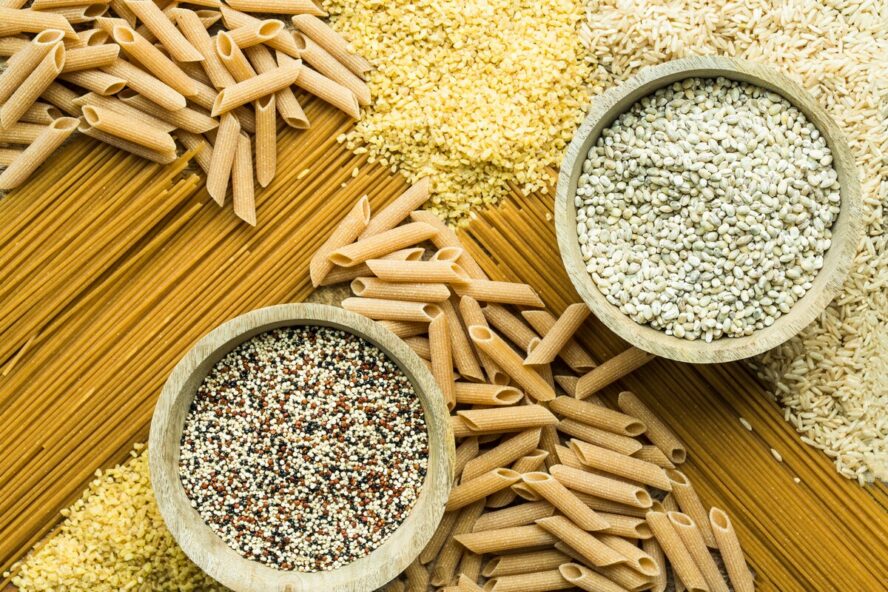
- Oatmeal (4g per cup cooked)
- Quinoa (5g per cup cooked)
- Brown rice (3.5g per cup cooked)
- Whole wheat pasta (6g per cup cooked)
- Barley (6g per cup cooked)
Nuts & Seeds
- Chia seeds (10g per 2 tbsp)
- Flaxseeds (6g per 2 tbsp ground)
- Almonds (3.5g per ounce)
- Pistachios (3g per ounce)
Surprising High-Fiber Options
- Dark chocolate (70%+ cacao: 3g per ounce)
- Popcorn (air-popped: 5.8g per 3 cups)
- Dried figs (7.5g per 1/2 cup)
- Coconut (4.6 grams per ounce)
How to Eat 30 Grams of Fiber Daily
Now that you know what foods are rich in fiber, you may be wondering how to hit 30 grams of fiber daily. We’ve taken the guesswork out of the equation and provided a few examples of how you can distribute fiber-rich foods throughout each day to reach that pivotal 30g total (and beyond).
The 30-Gram Formula
- Breakfast: 8-10g
- Lunch: 8-10g
- Dinner: 8-10g
- Snacks: 4-6g
- Total: 30-36g daily
Sample Day 1: Mediterranean-Inspired
- Breakfast: Oatmeal (4g) with berries (4g) and chia seeds (5g) = 13g
- Lunch: Lentil soup (8g) with whole grain bread (3g) = 11g
- Snack: Apple with almond butter (5g)
- Dinner: Quinoa bowl with black beans and vegetables (9g)
- Total: 38g
Sample Day 2: Plant-Based
- Breakfast: Avocado toast on whole wheat (7g) with side of berries (4g) = 11g
- Lunch: Chickpea salad with vegetables (10g)
- Snack: Pear with nuts (6g)
- Dinner: Stir-fry with brown rice, edamame, broccoli (11g)
- Total: 38g
Sample Day 3: For Busy Days
- Breakfast: High-fiber cereal (10g) with banana (3g) = 13g
- Lunch: Turkey wrap with whole wheat tortilla and veggies (8g)
- Snack: Popcorn (3.5g)
- Dinner: Grilled chicken with sweet potato (6.5g) and Brussels sprouts (4g) = 10.5g
- Total: 35g
High-Fiber Breakfast Ideas
If these full day plans feel overwhelming to you, try starting your day with a high-fiber breakfast containing 8 to 12 grams to get things off to a good start. This morning dose of fiber can help you control blood sugar better throughout the day, keep you fuller until lunch time, and simply help your gut feel its best. It’s also a massive first step towards helping you hit that goal of 30 grams of fiber.
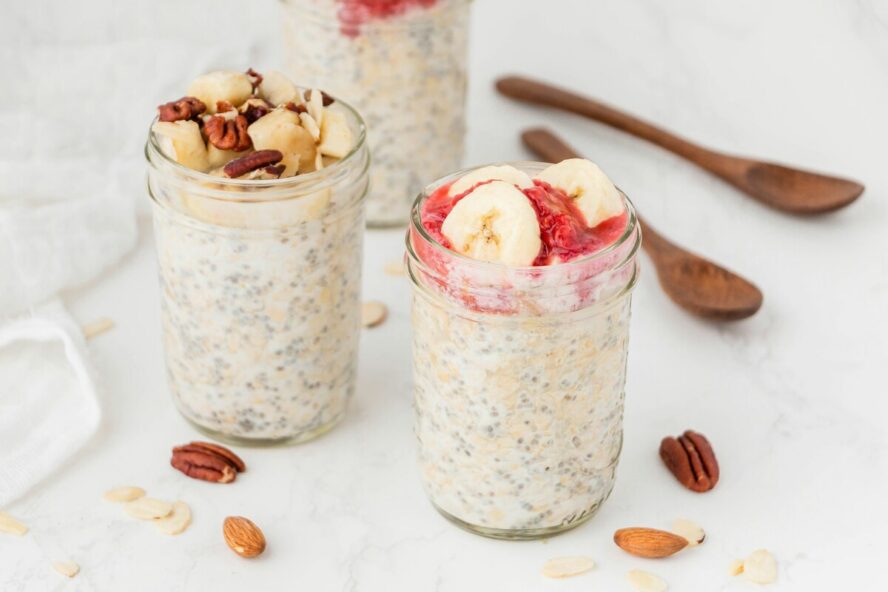
Here are some simple high-fiber breakfast ideas to help you get the day off on the right foot3,19:
- Overnight oats power bowl: Made from dried oats, flax seed, chopped or slivered almonds, and dried fruit mixed with milk. Pop this mixture into a jar or cup and allow it to set overnight in the fridge. Enjoy chilled or heat in the morning for a delicious high-fiber breakfast.
- Avocado toast: Spread mashed avocado on whole grain toast and garnish as desired for a simple high-fiber breakfast option.
- Smoothie bowls: Blend berries, chia seeds, banana, and yogurt — or try blending your preferred fruits, nuts, and seeds — to create a flavorful, fiber-rich option.
- Breakfast burrito: Use a whole wheat tortilla as a base for beans, scrambled eggs, and sauteed vegetables for an easy on-the-go breakfast that’s as filling as it is delicious.
- Add-on fiber to any breakfast meal: If you don’t want to reinvent the wheel, try just sticking to your normal breakfast (whether that’s oatmeal, cereal, or yogurt) and simply add nuts, seeds, or fruit as an extra fiber boost.
Smart Swaps: Easy Ways to Add 5-10 Grams Daily
If you’re not ready to reconstruct your entire diet from the ground up, there are some simpler ways to modify your current diet to maximize the amount of fiber you’re getting. Try some of the swaps below to help you elevate what you eat20,21.
Breakfast Swaps
- White bread toast → Whole wheat bread (+1-2g)
- Regular cereal → High-fiber cereal (+5-10g)
- Flour tortilla → Whole wheat tortilla (+1-3g)
Lunch & Dinner Swaps
- White rice → Brown rice or quinoa (+1-2g)
- Regular pasta → Whole wheat or chickpea pasta (+5-8g)
- Iceberg lettuce → Spinach or kale (+1g)
- Mashed potatoes made with peeled white potatoes → Mashed sweet potato with skin (+4g)
Snack Swaps
- Chips → Popcorn (+2-3g)
- Candy → Dark chocolate (+2-3g)
- Crackers → Apple with nut butter (+4-6g)
Invisible Fiber Additions
- Add ground flaxseed to smoothies (+3g per tbsp)
- Sprinkle chia seeds on yogurt (+5g per tbsp)
- Add beans to any soup or salad (+7-8g per half cup)
- Include vegetables at every meal
High-Fiber Foods for Weight Loss
Since fiber can help you stay full longer in between meals, it’s understandable that many turn to high-fiber foods for weight loss. And for good reason — research shows that eating more fiber can indeed support weight loss efforts by increasing satiety, which may then help reduce calorie density of meals. It has also been shown to slow digestion to help prevent blood sugar crashes, and it could help regulate fat metabolism22.
In fact, one study shows that higher fiber intakes are linked with lower visceral adiposity, or fat around the organs23. This property can help lower all-cause mortality and incidence of obesity over time24,25. Also, a 2023 study of individuals involved in a weight loss program shows that higher intakes of vegetables and fruits resulted in greater weight loss26.
The GLP-1 Connection
High-fiber diets may also help support weight loss through their GLP-1 connection. A 2026 study reports that high fiber intake may increase natural GLP-1 production in the gut. It does this through the fermentable fibers producing short chain fatty acids, which play a role in releasing GLP-1. In turn, fiber can help support natural appetite regulation27. Fiber-rich foods are just some of the foods you can eat to help support natural GLP-1 production in the body.
Research-Backed Results
Studies show high-fiber diets could lead to 5 to 10% weight reduction over 6 to 12 months28. And the best part is that this method of weight loss works without feeling restrictive, since fiber keeps you feeling full. For this reason, a high-fiber diet is likely more sustainable long-term when compared to more restrictive fad diets.
Best High-Fiber Foods for Weight Loss
The best high-fiber foods for weight loss are those that have a higher fiber-to-calorie ratio. Examples of such foods include legumes, vegetables, berries, oats, and chia seeds. Some other high-fiber foods for weight loss include high-protein options like lentils, chickpeas, and edamame, which can easily replace animal products in your meals. This makes such fiber-rich foods a perfect contender for meatless meals and plant-based diets.
How to Increase Fiber Without Bloating: The Gradual Approach
The key to increasing your fiber intake is to do so without overloading your digestive system. If you ramp up your fiber too fast, you may end up experiencing bloating, gas, and abdominal discomfort. Follow this ramp-up plan to slowly increase your fiber intake over time.
The 3-Week Ramp-Up Plan
Week 1: Add 5 grams (target 20-22g total)
- Start with: One high-fiber breakfast swap
- Add: One serving of fruit or vegetables daily
- Increase water to 8 cups daily
Week 2: Add another 5 grams (target 25-27g total)
- Add: Beans to one meal
- Swap: White grain to whole grain at lunch
- Increase water to 10 cups daily
Week 3: Reach 30+ grams
- Add: At least one high-fiber snack
- Maintain: Fiber at every meal and 10+ cups water daily
HOT TIP: If you experience gas and bloating while increasing fiber intake, try focusing on cooked vegetables — they’re easier to digest than raw vegetables. If you find you’re experiencing diarrhea during your fiber journey, try reducing fiber temporarily before increasing more slowly over time.
The Water Rule
As you start to up your fiber consumption, make sure to consume a minimum of 8 cups of water (64 oz) daily. When you begin to hit more than 30 grams of fiber daily, you may need to increase your water intake to around 10 to 12 cups.
Because fiber absorbs water, water should be treated as a critical part of your fiber-boosting journey. If you don’t drink enough water, you’ll be at higher risk for constipation and related digestive issues.
Fiber for Women: Special Considerations
As with almost all nutrients, it’s worth being conscious of how women’s fiber needs vary slightly from men’s.
Fiber Benefits Specific to Women
Since women typically have lower calorie needs than men, they also have proportionally less fiber needs daily. Unfortunately, even with a lower 25g daily recommendation, most women only consume around 15g daily.
For women specifically, fiber can support hormonal health. Studies show that fiber may help regulate estrogen levels and could reduce premenstrual syndrome (PMS) symptoms30,31.
Pregnancy & Breastfeeding

While pregnant or breastfeeding, fiber needs will increase. Fiber needs are around 28g daily during pregnancy and 29g daily during breastfeeding32,33. This increase in fiber during these stages of life helps to prevent pregnancy-related constipation as well as supporting a healthy birth weight for your child34.
Menopause Considerations
After the age of 50 years, the recommended fiber intake drops slightly lower to 21g daily1. This lower level of fiber intake strikes a delicate balance — enough to support gut and bone health with the prebiotic effects of fiber, but not too much that it causes bloating and gas when coupled with the age-related slowing of digestion35.
Frequently Asked Questions
It’s always possible to have too much of a good thing, even with fiber. For many people, over 50 grams of fiber per day can cause bloating, abdominal pain, and constipation. Do your best to consume fiber in moderation — aiming for the 30 grams per day mark will benefit health without causing digestive harm.
Fiber supplements can help slow down digestion and increase satiety, but fiber from whole foods has the added benefit of providing important nutrients and antioxidants that can further support overall health. Therefore, only use fiber supplements if you are recommended to do so by a trusted health professional.
If you have irritable bowel syndrome (IBS) or other digestive issues, experts suggest consuming mostly soluble fibers that are easier for the gut to process36. Psyllium, a low-fermentable fiber, is especially recommended for such situations, but you should always consult with your healthcare team for dietary information with regards to your specific health situation.
Cooking foods may make fiber-rich foods easier to digest, but it does not reduce the total fiber content of foods37. While cooking fiber-rich foods helps to decrease hard-to-digest insoluble fiber, it actually increases soluble fiber content, so the total fiber content stays roughly the same38.
It is not necessary to track fiber every day to benefit from it, although it can help you be more conscious of your intake. If you’re curious about your baseline fiber intake, tracking can help you determine your starting point so you know how much more fiber you should eat each day to meet daily recommendations. Otherwise, simply try to include more fiber rich foods in your meals and snacks each day to help support gut and overall health.
Key Takeaways
As you can see, eating 30 grams of fiber per day is achievable with a whole foods approach. The key to enjoying the benefits of fiber is to gradually increase your daily intake, ensure proper hydration to reduce digestive symptoms, and to include a diversity of fiber-rich food sources to keep your diet interesting.
And as is best with all health changes, make small, consistent changes over time. Start with increasing fiber at breakfast tomorrow morning, then listen to your body and slowly increase fiber at other meals and snacks. You’ll be meeting your fiber goals and reaping the benefits before you know it.
Sources:
- https://pmc.ncbi.nlm.nih.gov/articles/PMC8621412/
- https://www.mayoclinic.org/healthy-lifestyle/nutrition-and-healthy-eating/in-depth/fiber/art-20043983
- https://www.health.harvard.edu/blog/should-i-be-eating-more-fiber-2019022115927
- https://www.musc.edu/content-hub/news/2022/08/30/increasing-daily-fiber-intake
- https://pmc.ncbi.nlm.nih.gov/articles/PMC10180651/
- https://pmc.ncbi.nlm.nih.gov/articles/PMC9298262/
- https://med.stanford.edu/news/all-news/2021/07/fermented-food-diet-increases-microbiome-diversity-lowers-inflammation.html
- https://pmc.ncbi.nlm.nih.gov/articles/PMC10498976/
- https://pmc.ncbi.nlm.nih.gov/articles/PMC11819994/
- https://pmc.ncbi.nlm.nih.gov/articles/PMC10488173/
- https://www.ahajournals.org/doi/10.1161/STROKEAHA.124.049093
- https://pmc.ncbi.nlm.nih.gov/articles/PMC11671356/#sec8
- https://www.jstage.jst.go.jp/article/jat/advpub/0/advpub_65864/_article
- https://pmc.ncbi.nlm.nih.gov/articles/PMC9268622/
- https://pmc.ncbi.nlm.nih.gov/articles/PMC6124841/
- https://www.mayoclinic.org/healthy-lifestyle/nutrition-and-healthy-eating/in-depth/high-fiber-foods/art-20050948
- https://www.dietaryguidelines.gov/sites/default/files/2024-08/Food-Sources-Fiber-Standard-508C.pdf
- https://fdc.nal.usda.gov/food-details/170273/nutrients
- https://pmc.ncbi.nlm.nih.gov/articles/PMC12696374/
- https://www.ncbi.nlm.nih.gov/books/NBK589559/table/usdaddb12.tab1/?utm
- https://www.nal.usda.gov/sites/default/files/page-files/Total_Dietary_Fiber.pdf
- https://www.frontiersin.org/journals/nutrition/articles/10.3389/fnut.2024.1510564/full
- https://www.sciencedirect.com/science/article/abs/pii/S1871403X26000037?via%3Dihub
- https://www.mdpi.com/2079-9721/13/8/272
- https://www.frontiersin.org/journals/nutrition/articles/10.3389/fnut.2025.1602600/full
- https://www.frontiersin.org/journals/nutrition/articles/10.3389/fnut.2023.1110748/full
- https://www.mdpi.com/2072-6643/18/4/564
- https://www.sciencedirect.com/science/article/pii/S0022316622164503
- https://pmc.ncbi.nlm.nih.gov/articles/PMC12125019/#sec16-15598276251344827
- https://pmc.ncbi.nlm.nih.gov/articles/PMC7875566/
- https://pmc.ncbi.nlm.nih.gov/articles/PMC9928757/
- https://pmc.ncbi.nlm.nih.gov/articles/PMC7824257/
- https://pmc.ncbi.nlm.nih.gov/articles/PMC6710673/
- https://pmc.ncbi.nlm.nih.gov/articles/PMC7824257/
- https://pmc.ncbi.nlm.nih.gov/articles/PMC9439193/
- https://pmc.ncbi.nlm.nih.gov/articles/PMC8999090/
- https://www.uhhospitals.org/blog/articles/2023/11/raw-vs-cooked-vegetables
- https://pmc.ncbi.nlm.nih.gov/articles/PMC11821131/


