



Heart Space Meditation, or Hridayakasha Dharana, invites you to enter the inner space of the heart and meet your feelings with clarity and awareness.
In Sanskrit, hridaya means “heart,” and akasha means “space.” Hridayakasha Dharana often translated as Heart Space Meditation is a yogic practice that teaches you to connect with the inner space of the heart and observe your emotions with clarity and compassion.
This meditation is unique because it doesn’t avoid emotions. Instead, it guides you to feel, intensify, and witness emotions inside the heart center so that old impressions, memories, and emotional patterns can rise, soften, and eventually release.
Some people experience the practice as gentle; others find it deeply intense. The difference usually depends on how openly emotions arise. Because of this, many teachers recommend learning Hridayakasha Dharana under proper guidance.
What makes heart space meditation special
This practice has a strong psychotherapeutic and spiritual dimension. By working with feelings in a conscious way, suppressed impressions (samskaras) often rise to the surface. As you watch them without judgement, their emotional charge begins to soften. This allows many inner knots, childhood memories, and long-held emotional patterns to gradually resolve.
Hridayakasha Dharana teaches you to:
- Help uncover suppressed emotions
- Soften deep-rooted emotional patterns
- Bring childhood impressions to the surface
- Support emotional regulation and resilience
- Strengthen your connection with your inner self
It is an active meditation where you work with feelings, yet remain rooted in witnessing.
Before you begin: A few important guidelines
- Don’t try to fix or force your feelings. Your role is to observe.
- Avoid overthinking or analyzing the emotion- keep it experiential.
- Let reactions rise naturally. Don’t suppress them.
- If you feel overwhelmed, slow down or pause.
- Beginners should ideally work with an experienced teacher.
Join Our 6-Day Live Yoga Nidra & Meditation Workshop
Stages of hridayakasha dharana(Heart space meditation)
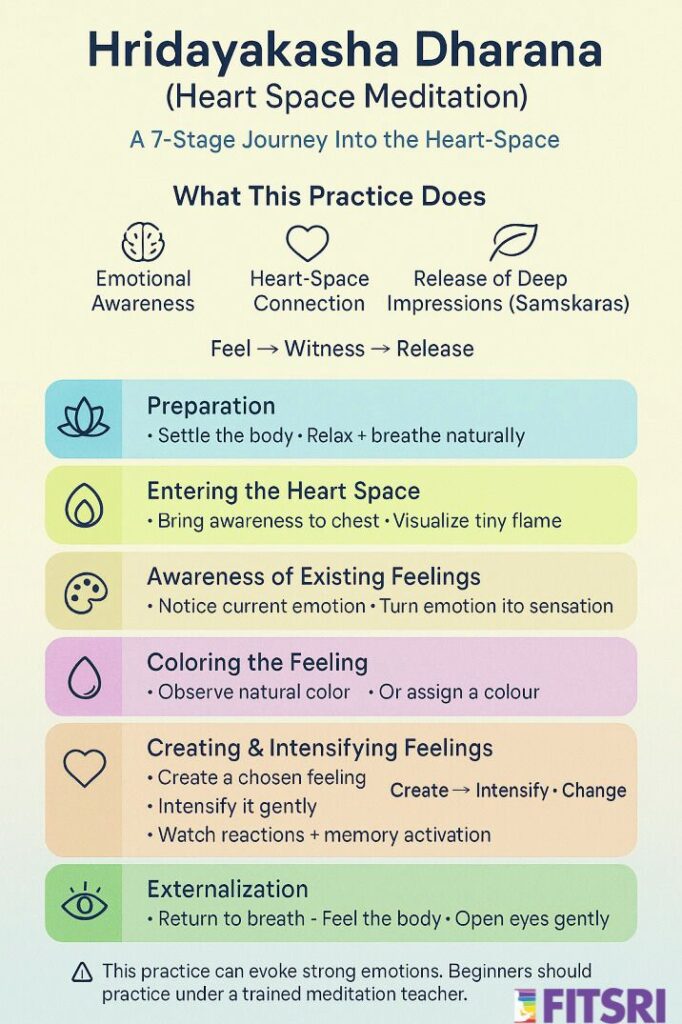
Below are the key stages of the practice, written clearly while keeping the original meaning intact.
1. Settle In (Preparation)
Sit comfortably and relax the whole body. Scan through each part and soften any tension. Allow the breath to move naturally and gently settle into stillness.
Feel the silence and solitude inside you. Let the entire body become calm, steady and quiet.
2. Entering the heart-space
Bring awareness to the chest region. Sense the space within the chest cavity. Feel the breath pulsating inside this inner space. Allow the heart-space to become expansive, silent and still.
Visualise a tiny flame inside the heart. With each inhalation, the flame brightens; with each exhalation, it softens to a warm glow. Let its light fill the entire inner space of the heart.
3. Notice what you’re feeling
Notice the feeling that already exists in you now – anxiety, peace, excitement, contentment, happiness, silence, or anything else.
Acknowledge the feeling and convert it into a sensation. Feel its texture, temperature, weight, movement, or pressure. Then gently develop the feelings of peace, contentment and warmth. If a new feeling replaces the earlier one, simply notice the change.
4. Add a color to the feeling
Observe if a spontaneous colour appears with the feeling. See the entire heart-space saturated with that colour.
If no colour arises, gently create a feeling and give it a colour that you associate with it. If the same feeling stays for a long time, create another feeling and observe a fresh colour.
The focus is on colour observation, not analysing why the colour appears.
5. Create and intensify a feeling
Now move beyond natural feelings and begin creating feelings intentionally.
Create a feeling for example, love- using a memory, person, or situation if needed. Let it arise in the heart-space and intensify it slowly. Observe the colour and sensations that come with it.
Sometimes the reaction will trigger a different feeling or memory. Watch it with detached awareness. These reactions are part of the memory activation process.
Create → Intensify → Change
This three-step rotation is central to the practice.
Examples:
- Create the feeling of silence by imagining yourself deep under the ocean.
- Create the feeling of being born- the transition from the womb to the outer world.
- Intensify the sense of primitive insecurity that comes with this memory.
- Change the feeling to anxiety.
- Then shift into the feeling of drifting into sleep.
- Change again to silence.
You are training the mind to move through feelings without attachment.
6. Explore early childhood memories
Now bring up childhood memories, especially the earliest ones.
See the memory unfolding like a movie. Observe:
- The place
- The people
- Words spoken
- Smells, movements, details
- The feelings the child experienced
Witness the impact the event had on the child and how its impression still lives in your heart today.
Do not judge or analyse. You are a visitor watching the past.
When the emotional charge of one memory settles, move to another.
This stage helps release deep samskaras formed in early life.
7. Return to the present (externalization)
Gently bring back awareness to the breath, body and surroundings. Feel the body sitting in the present moment. Open your eyes slowly.
Why this practice heals
Heart Space Meditation heals by allowing emotions to fully arise within a safe, conscious space. When emotions are held with awareness instead of suppression, they lose their intensity and the mind becomes clearer.
Over time, you gain:
- Emotional strength
- Freedom from old patterns
- Greater self-awareness
- A calmer, kinder relationship with your own heart
Conclusion
Hridayakasha Dharana or Heart Space Meditation is a powerful practice for emotional healing, inner listening, and deep personal clarity. By learning to witness feelings without being overwhelmed, you open the heart to greater ease and insight. Because this process can evoke strong reactions, it’s best practice with a teacher who can guide you safely through the experience.
This meditation invites you to meet your inner world honestly and to discover the spaciousness that already exists within your own heart.

