


Learn why Kundalini Yoga is not an advanced practice but a complete system that deepens Hatha yoga for teachers and serious practitioners.
Many yoga teachers feel confident guiding postures and breath, yet quietly sense that something deeper is missing. Not a flaw in their training, but a dimension of yoga that the body alone cannot reach. This reflection often becomes the doorway to Kundalini not as a higher or elite practice, but as the aspect that completes the journey yoga has always pointed toward.
Most yoga teachers carry strong asana knowledge into their classrooms. They sequence with confidence, hold a room with presence, and guide students through the breath with care. And yet, somewhere along the path of teaching often quietly, sometimes with a growing sense of frustration — there comes a feeling that something is missing. A depth that the body-centred practice alone does not reach. A layer the postures do not touch.
This is the moment that brings many experienced teachers to the study of Kundalini. Not because their previous training was inadequate, but because Hatha yoga, as it is most commonly taught today, presents only one dimension of a much larger and older system. Kundalini yoga does not sit above that system as some final destination. It completes it.
The common misunderstanding around kundalini yoga
There is a widely held belief that Kundalini yoga is only for advanced practitioners something to approach after years of posture practice, something esoteric, perhaps even risky. Within the Bihar tradition, this understanding is seen differently. Kundalini is not a higher level one graduates to. It is the very foundation of what yoga has always been concerned with: the expansion of awareness and the refinement of energy.
Kundalini and Kriya yoga traditions are rooted in Tantra not in the modern, commercial use of the word, but in its original meaning. The Sanskrit roots tan (to expand) and tra (to liberate) point to a process of expanding consciousness and freeing energy from limiting patterns. When this is understood, it becomes clear that every asana, every pranayama, and every meditation technique in the classical tradition was always moving toward this awakening.
The serpent was never sleeping in some distant corner of practice. It has always been coiled at the centre of it.
What modern yoga teacher trainings often miss
A standard 200-hour Hatha yoga teacher training offers a solid working knowledge of asana, pranayama, and usually a brief introduction to the chakra system. Yet when we look closely at how these subjects are often taught, a pattern becomes visible. The chakras are presented as theory- a map to remember rather than a reality to experience. Pranayama is simplified into breathing techniques with physical benefits. Bandhas are explained in anatomical language “engage your pelvic floor,” “lift the perineum” without exploring what energy is being directed or why.
This is not a criticism of these trainings. It is simply the natural boundary of a system designed primarily to teach the physical dimension of yoga. The limitation becomes evident when a teacher begins to notice that students are arriving with experiences that alignment cues alone cannot address — grief, emotional heaviness, restlessness, or a sense of disconnection that no amount of Shavasana seems to resolve.
In these moments, a teacher trained only in the physical vocabulary of yoga may feel something important is missing not skill, but a language for the deeper layers of experience.
Kundalini provides that vocabulary. And it does so through direct experience, not theory.
How kundalini creates a complete yogic practice
Kundalini practice brings together the different dimensions of yoga so they are experienced as one process rather than separate techniques.
In the Kundalini and Kriya yoga teacher training at India, four primary streams are explored together: chakra-oriented asana, pranayama integrated with mudra and bandha, the philosophical foundations of Kundalini and Tantra, and the direct practices of Kriya and chakra meditation. These are not separate subjects but different expressions of the same inquiry, each supporting and clarifying the others.
Consider asana in this context. A posture is not only a physical shape but a way of directing awareness. Practices from the Pawan Muktasana series, the forward bending sequence, and the Vajrasana group are chosen with specific chakra awareness in mind. Drishti (gaze) gradually deepens into Dharana (inner concentration), shifting attention from outward form toward inner experience. Bandha is understood not simply as muscular engagement, but as the conscious guidance of prana.
The same depth extends to pranayama. Preparatory practices first stabilise the nervous system before introducing techniques such as Nadi Shodhana with Antar Kumbhaka, Bhastrika, Kapalbhati, or Ujjayi practised with Khechari Mudra. When Bhramari is approached with chakra awareness rather than only as a calming breath, the vibration of sound itself becomes a pathway inward, gently drawing the mind toward subtler perception.
Through this integration, practice begins to feel less like a series of methods and more like a unified journey. Body, breath, mind, and energy are explored together, each revealing the others.
Mudra and bandha – understanding the language of energy
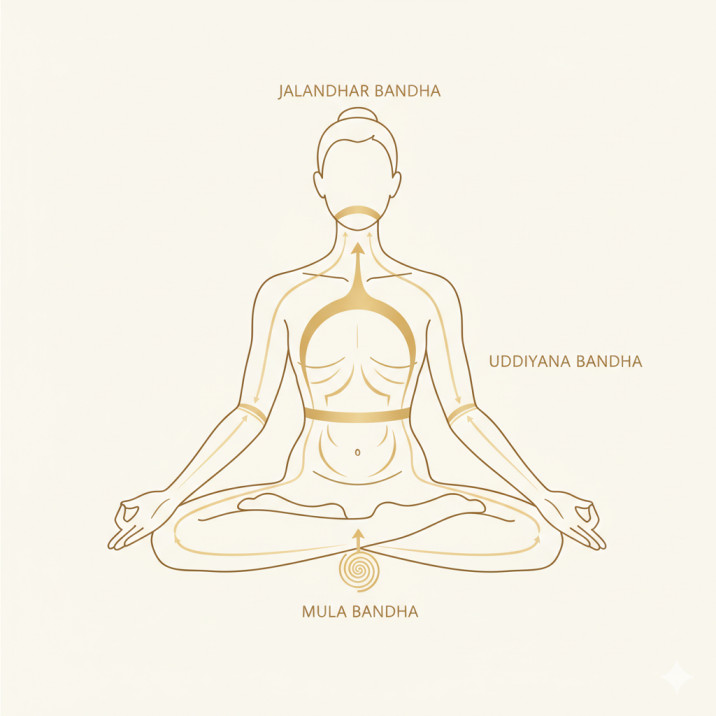
Mudra and Bandha are often the areas where yoga begins to move from physical technique into energetic experience, yet they are also where many teachers feel they have only touched the surface.
Jalandhara Bandha, Mula Bandha, and Uddiyana Bandha are familiar by name, yet their traditional understanding extends far beyond anatomical instruction.
In the Kundalini tradition, mudras are described as psycho-physical gestures a term that reflects how they influence both body and mind at the same time. Shambhavi Mudra, the gentle awareness at the eyebrow centre, is not simply a method of concentration but a direct way of awakening the field of perception associated with Ajna Chakra. Nasikagra Drishti steadies the mind through a subtle convergence of attention, while practices such as Ashwini Mudra and Vajroli Mudra engage deeper layers of the pranic body, particularly in relation to Muladhara and Swadhisthana.
Maha Bandha, the combined application of the three primary locks, is regarded as one of the most powerful practices in the Hatha and Kundalini traditions. When approached with proper preparation and guidance, it reveals dimensions of inner experience that posture practice alone cannot access.
Through these practices, the language of yoga gradually shifts from muscular effort to energetic awareness. Practitioners begin to sense not only how a technique is performed, but what it is doing within the subtle body.
Chakras in kundalini yoga: Beyond theory
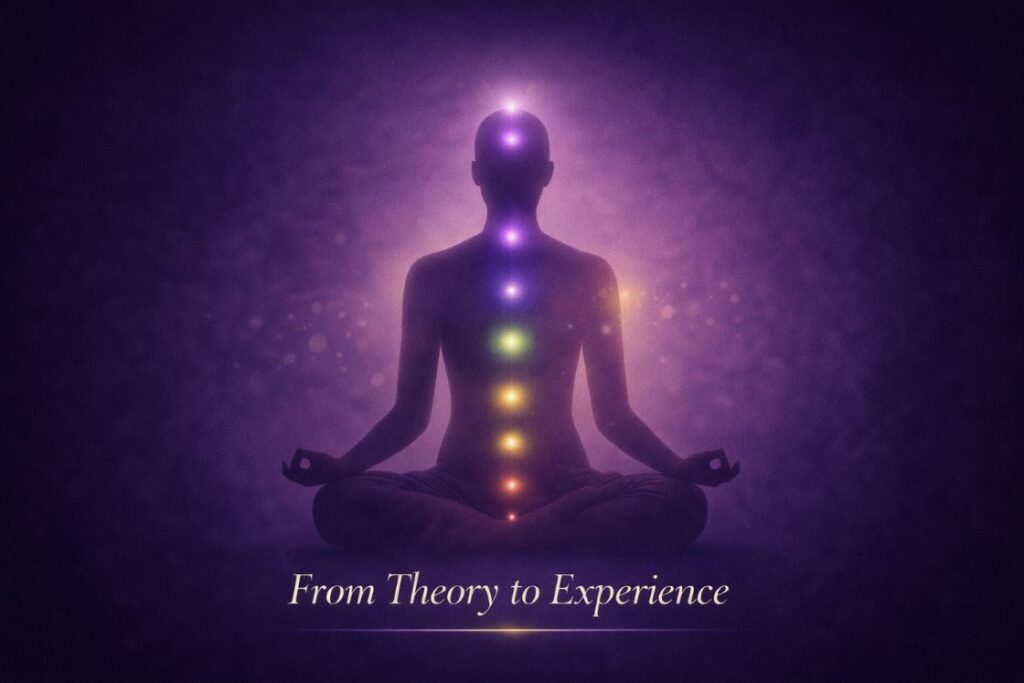
In contemporary yoga culture, the chakra system is often introduced through colour-coded diagrams– useful as an entry point, yet far removed from the living reality these centres represent. In a traditional Kundalini approach, chakra work is not merely conceptual. It is something to be experienced directly.
Each chakra is understood not only by its location along the spine but also through its Kshetram – a corresponding trigger point on the front of the body. Practitioners learn to recognise these centres through awareness and practice rather than imagination. Structured activation sessions for Muladhara, Swadhisthana, Manipura, Anahata, Vishuddhi, and Bindu-Visarga combine specific mudras, pranayamas, and meditative techniques designed to purify and awaken each centre gradually and safely.
Manipura Chakra, the solar plexus centre, is approached through practices such as Agnisara Kriya, Uddiyana Bandha, and Nauli in its three forms – Madhyama, Vama, and Dakshina. These methods generate internal heat, strengthen the digestive fire, and awaken the quality of will. Anahata Chakra, the heart centre, is explored through Ajapa Japa the natural mantra of the breath along with Dharana practices that reveal what the tradition calls Hridayakasha, the inner space of the heart.
As understanding deepens, teachers begin to recognise how each chakra also reflects psychological tendencies. Muladhara relates to stability and security, Swadhisthana to emotional flow and creativity, and Manipura to personal power and direction. With this awareness, a class can be shaped not only for physical benefit but to support the student’s inner condition as well.
Meditation in kundalini: A systematic inner science
The meditation practices within the Kundalini tradition form a complete system in themselves. They are not simply a short relaxation at the end of a class, but a progressive and carefully structured exploration of awareness.
Kaya Sthairyam develops physical stillness and mental steadiness, creating the foundation upon which deeper practices can unfold. Antar Mouna, the practice of inner silence, moves through distinct stages awareness of external sounds, observation of spontaneous thoughts, and eventually the conscious creation and dissolution of thought. This progression mirrors the movement from Pratyahara to Dharana and gradually toward Dhyana described in the classical yogic framework.
Yoga Nidra, often understood today as guided relaxation, is approached in three stages within the Kundalini tradition. The beginner stage cultivates awareness of the physical body through rotation of consciousness. The intermediate stage introduces awareness of psychic passages and chakras. The advanced stage works with subtler symbols, Tattvas, and deeper states of perception. A teacher familiar with these stages can guide students with sensitivity, meeting them where they are.
Trataka, the steady gazing practice, purifies the visual field and strengthens concentration. When combined with Shambhavi Mudra and mantra awareness, it becomes a powerful Dharana technique for awakening the intuitive field associated with Ajna Chakra. Practices related to Bindu-Visarga — including Yoni Mudra, subtle sound awareness, and inward breath-attitude guide attention toward increasingly refined states of inner experience.
Through this systematic approach, meditation is no longer an isolated technique but an integrated path of inner development.
How Kundalini training transforms teaching
When a yoga teacher engages sincerely with Kundalini training, the change in their teaching is often subtle yet profound. It is not a dramatic shift, but more like the difference between understanding a place through description and knowing it through experience. Theoretical knowledge begins to settle into lived awareness.
Sequencing becomes guided by intention rather than habit. Postures are chosen not only for how they flow, but for how they influence energy and attention. The teacher gradually learns to sense the atmosphere of a room in a more intuitive way what the tradition refers to as Prana-Vidya, the understanding of energy. Kriyas, specific mudras, and focused pranayama can then be woven into a Hatha class in a way that deepens the experience without losing the physical foundation students rely on.
Perhaps most importantly, the teacher develops a wider sensitivity to the range of human experiences present in the room. A student struggling to release in a posture may be working with emotional patterns related to Swadhisthana. Another who constantly pushes may be expressing an imbalance at Manipura. Someone quiet and withdrawn may need a very different approach than the student who naturally takes the front row. Kundalini training offers tools to recognise these nuances and respond with greater precision and care.
In this way, teaching shifts from guiding movements to supporting a process of inner development.
The responsibility of working with kundalini practices
There is a reason Kundalini teachings have traditionally been shared with care, often within a close teacher–student relationship built on trust. These are not techniques to be applied casually. Their effects are tangible, and it is precisely this effectiveness that calls for understanding rather than mere instruction.
A thorough grounding in Kundalini offers more than a collection of practices. It provides a coherent philosophical framework an understanding of prana, of the relationship between energy and consciousness, and of the role a teacher truly plays in a student’s unfolding. The classical Tantra and Kundalini texts are not peripheral to yoga; they form part of its inner architecture.
For teachers who feel a quiet but persistent pull toward deeper study, this feeling is not simply curiosity. It is often the natural response to encountering the limits of a purely physical approach. When approached with sincerity and proper guidance, Kundalini training becomes less about acquiring techniques and more about cultivating responsibility, clarity, and humility in the teaching process.
Kundalini as the natural direction of yoga
For those who feel drawn toward Kundalini, the movement is rarely sudden. It often begins as a quiet recognition that yoga is pointing toward something deeper than technique alone. Not an ambition to reach a higher level, but a natural curiosity about the fuller scope of the tradition.
Kundalini is not where yoga ends, nor is it a specialised path reserved for a few. It is the underlying thread that runs through asana, pranayama, and meditation- the dimension that brings coherence to the entire practice. When approached with patience, guidance, and respect for the lineage from which it comes, it reveals yoga not as a collection of methods, but as an integrated process of inner transformation.
For teachers, this understanding brings a shift in perspective. Teaching becomes less about delivering sequences and more about holding a space where body, breath, mind, and energy can be explored together. The classroom becomes not just a place of practice, but a place of unfolding.
This article is based on the curriculum of the 200-hour Online Kundalini Yoga Teacher Training program offered by Bihar Yoga School, Rishikesh. The program draws from traditional Hatha Yoga, Kundalini, Kriya, and Tantra texts and is designed for yoga teachers seeking to deepen their practice and expand the scope of their teaching.

