


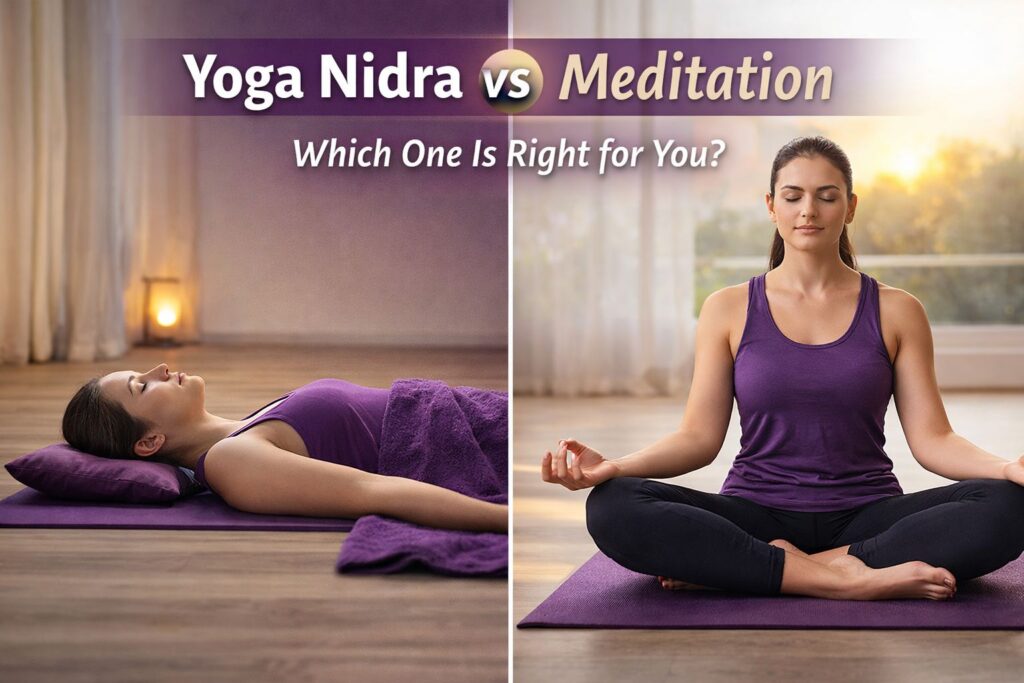
Yoga Nidra and meditation are often confused, but they are not the same. Yoga Nidra is a guided practice done lying down that brings you into a state between waking and sleep, allowing deep rest and subconscious healing. Meditation, on the other hand, is an active mental practice usually done sitting upright, where you train the mind to focus, observe, and stay aware.
Both practices come from the classical yoga tradition, but they work in different ways. Yoga Nidra requires little effort and is accessible even for beginners, while meditation builds concentration and awareness over time through consistent practice.
The key difference is how they work: one relaxes the body deeply, while the other trains the mind.
In simple terms, Yoga Nidra is about effortless relaxation and inner restoration, while meditation is about active awareness and mental training. When practiced together, they complement each other and support deeper inner growth.
In this guide, you’ll understand the difference between Yoga Nidra and meditation, how each works, their benefits, and which one is right for you.
Yoga Nidra vs Meditation: Key Differences at a Glance
If you want a quick answer, this table shows the main difference between Yoga Nidra and meditation in a simple way.
| Yoga Nidra | Meditation | |
|---|---|---|
| Posture | Lying down in Shavasana (fully relaxed position) | Seated upright with a straight spine |
| Type of practice | Guided relaxation and awareness practice | Self-directed mental focus practice |
| Effort required | Very low — simply follow the guidance | Moderate to high — requires focus and attention |
| State of mind | Between waking and sleep (deep relaxation state) | Fully awake and alert (focused awareness) |
| Main purpose | Deep rest, stress relief, anxiety reduction, healing | Mental clarity, focus, emotional balance |
| Brainwave activity | Alpha → Theta → Delta (deep restorative state) | Beta → Alpha → Theta (gradual calming of mind) |
| Duration | 20–45 minutes (deep relaxation session) | 10–30 minutes (can increase with practice) |
| Best for beginners | Very easy to start, no experience needed | Takes practice to develop focus |
| Best for sleep | Highly effective for sleep and insomnia | Not primarily designed for sleep |
| Yogic classification | Pratyahara (withdrawal of senses) | Dharana & Dhyana (concentration & meditation) |
| Tradition | Systematised by Bihar School of Yoga | Found in multiple traditions (Buddhist, Yogic, etc.) |
Yoga Nidra is best for deep relaxation and stress relief, while meditation is best for training the mind and improving focus.
What Is Meditation?
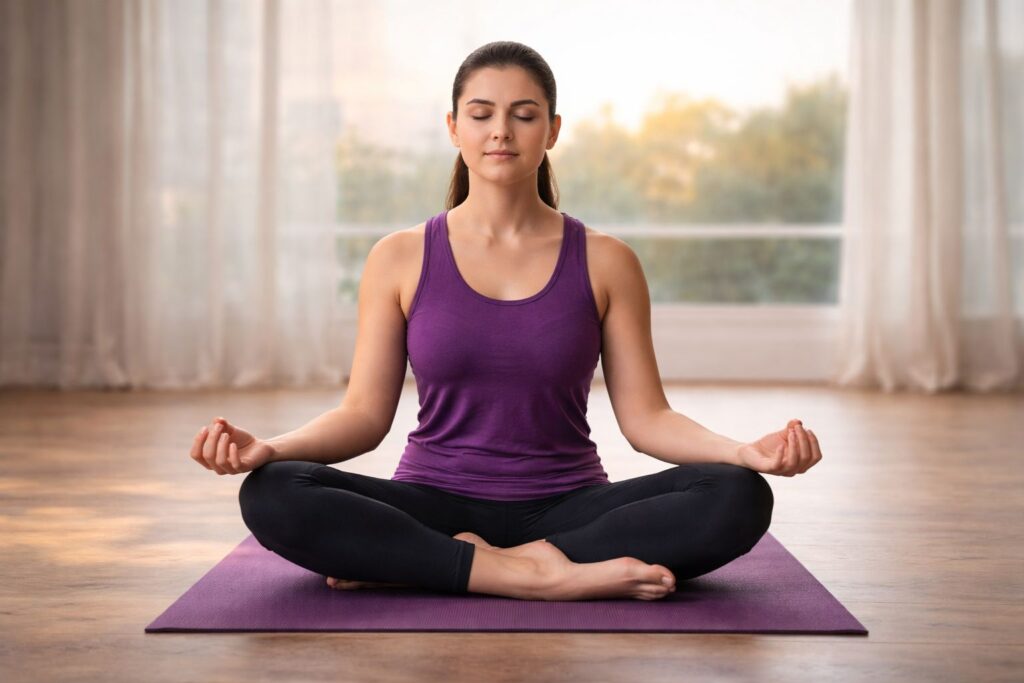
Meditation is a practice where you train your mind to stay focused, calm, and aware. It is usually done sitting upright, with your attention placed on something simple like your breath, a mantra, or your thoughts.
In simple terms, meditation is not about stopping your thoughts it is about observing them without getting carried away.
Meditation in Classical Yoga
In Patanjali’s Ashtanga Yoga (the eight-limbed path), meditation is known as Dhyana, the seventh limb. It is not the starting point, but a deeper stage that develops over time.
Before meditation, the practice moves through:
This shows that meditation is a skill that develops step by step, not something you achieve instantly.
Why Meditation Feels Difficult at First
Many people find meditation challenging in the beginning, and that’s completely normal.
Modern life keeps the mind constantly active. When you sit quietly:
- thoughts increase
- attention keeps shifting
- restlessness becomes more noticeable
This doesn’t mean you are doing it wrong. It simply means you are becoming aware of your mind.
The practice is simple:
👉 notice when your mind wanders
👉 gently bring it back
Over time, this builds focus, patience, and inner stability.
The key word is gradual. Meditation builds you from the inside out, but it asks something from you first sustained effort, consistency, and willingness to sit with ydiscomfort before the stillness comes.
Benefits of Regular Meditation
With consistent practice, meditation can help you:
- improve focus and concentration
- reduce stress and emotional reactivity
- develop mental clarity and awareness
- build long-term emotional balance
- support deeper self-awareness and inner growth
Research also shows that regular meditation can lead to positive changes in the brain, especially in areas related to attention and emotional regulation.
What Is Yoga Nidra?
Yoga Nidra means “yogic sleep.” It is a guided practice done lying down in Shavasana, where you enter a state between waking and sleep.
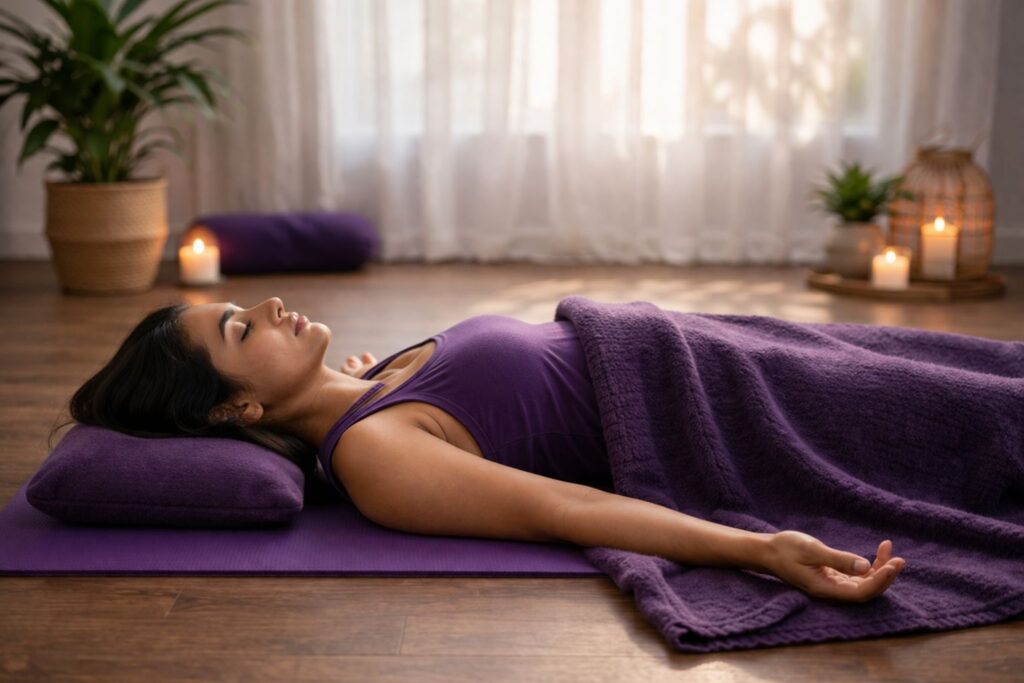
In this state, the body becomes deeply relaxed while the mind remains aware.
Unlike meditation, which requires effort and focus, Yoga Nidra is effortless you simply follow the guidance.
More Than Just Relaxation
Yoga Nidra is often described as guided relaxation, but it is much deeper than that.
It works at the level of the subconscious mind, where habits, emotions, and patterns are stored. This is why regular practice can lead to not just relaxation, but also inner change and healing.
Origin of Yoga Nidra (Bihar Tradition)
The modern system of Yoga Nidra was developed by Swami Satyananda Saraswati in the 1960s at the Bihar School of Yoga in India.
He adapted the ancient Tantric practice of Nyasa, where awareness is placed on different parts of the body, and made it accessible for modern practitioners.
This made it possible for people of any background to experience the deeper benefits of yoga without needing complex rituals or Sanskrit knowledge.
How Yoga Nidra Works
Yoga Nidra follows a systematic sequence that guides your awareness inward step by step.
The main stages include:
- Physical relaxation — settling into Shavasana and releasing tension
- Sankalpa (resolve) — setting a short, meaningful intention
- Rotation of consciousness — moving awareness through body parts
- Breath awareness — observing the natural breath
- Opposite sensations — experiencing pairs like heavy/light or warm/cool
- Visualisation — observing images or symbols
- Sankalpa (repetition) — reinforcing your intention
- Externalisation — gently returning to awareness
This process helps you move from the physical body to deeper layers of the mind.
Also Read: How to Practice Yoga Nidra
Why Yoga Nidra Is So Effective
Yoga Nidra works by bringing you into a state between waking and sleep (often called the hypnagogic state).
In this state:
- the body rests deeply
- the nervous system resets
- the mind becomes more receptive
This is why Yoga Nidra is widely used for:
- stress and anxiety relief
- better sleep
- emotional balance
- deep relaxation
The Science Behind Yoga Nidra and Meditation
Both Yoga Nidra and meditation are supported by growing scientific research. Studies show they affect the brain and nervous system in different ways which explains why they feel so different in practice.
Yoga Nidra and Deep Brain States:
Research shows that Yoga Nidra creates a unique brain state.
A 2022 EEG study found increased delta brainwave activity during Yoga Nidra the same brainwaves seen in deep sleep. However, participants remained aware.
This means:
- the body enters deep physical restoration
- while the mind stays consciously aware
Researchers describe this as an “awake state with local sleep” a rare condition where rest and awareness happen together.
This helps explain why Yoga Nidra is often experienced as deeply restorative, even without actual sleep.
Changes in Brain Networks (DMN)
Modern brain imaging studies show that Yoga Nidra affects the Default Mode Network (DMN) the part of the brain linked to:
- overthinking
- mind-wandering
- self-focused thoughts
A 2024 fMRI study (IIT Delhi & AIIMS) found:
- reduced DMN activity during Yoga Nidra
- less mental chatter
- a calmer internal state
More experienced practitioners showed stronger effects, suggesting that the benefits increase with practice.
Stress, Anxiety, and Emotional Health
Research consistently shows that Yoga Nidra is highly effective for reducing stress and anxiety.
- A comparative study found greater anxiety reduction with Yoga Nidra than seated meditation
- A large meta-analysis (73 studies, 5,000+ participants) confirmed improvements in:
- stress
- anxiety
- depression
This makes Yoga Nidra especially useful for people dealing with chronic stress, burnout, or emotional fatigue.
Cortisol and Stress Hormones
Yoga Nidra also affects the body at a hormonal level.
A 2025 clinical trial found that:
- even 11 minutes of daily practice reduced cortisol levels
- it improved the natural rhythm of stress hormones
This shows that Yoga Nidra does not just feel relaxing it creates measurable biological changes.
Sleep and Nervous System Reset
Sleep research shows that Yoga Nidra supports deep relaxation and recovery.
- A single session helped many participants with insomnia fall asleep
- it reduced breathing rate
- it activated the parasympathetic nervous system (rest-and-digest mode)
This explains why Yoga Nidra is widely used for better sleep and nervous system regulation
Yoga Nidra vs Meditation: The 6 Key Differences
Understanding the difference between Yoga Nidra and meditation becomes easier when you look at how they work in practice.
1. Posture – Lying Down vs Sitting Upright
Meditation is practiced sitting upright with the spine straight. This keeps the body alert and helps maintain focus.
Yoga Nidra is practiced lying down in Shavasana. This position allows the body to fully relax and signals safety to the nervous system, making it easier to enter deep rest.
2. Effort – Active vs Effortless
Meditation requires active effort. You focus your attention, notice distractions, and gently bring your mind back.
For beginners, this can feel difficult but that effort is part of the practice.
Yoga Nidra is effortless. You simply follow the guidance. Even if your mind drifts or you briefly fall asleep, the practice continues.
3. State of Awareness – Awake vs Between Sleep and Wakefulness
Meditation keeps you in a fully awake and alert state, training your awareness and attention.
Yoga Nidra takes you into a state between waking and sleep (often called the hypnagogic state), where the body rests deeply while awareness remains.
4. Guidance – Self-Directed vs Fully Guided
Meditation is usually self-directed. You practice techniques like breath awareness or mantra on your own.
Yoga Nidra is fully guided. The teacher’s voice leads the practice, helping you stay aware as you move into deeper states of relaxation.
5. Depth of Experience – Mental vs Whole-System
Meditation mainly works with the mind improving focus, awareness, and emotional balance.
Yoga Nidra works on multiple layers of your being (body, breath, mind, and deeper awareness), helping release tension at all levels.
6. Sankalpa A Unique Feature of Yoga Nidra
One of the key differences is the use of Sankalpa (a personal resolve).
In Yoga Nidra:
- you set a short, meaningful intention
- repeat it when the mind is deeply relaxed
In this state, the subconscious mind becomes more receptive, allowing the intention to take root more deeply.
Also Read: Sankalpa: Why Your Intention Matters in Deep Relaxation
This is what makes Yoga Nidra not just relaxing, but also transformational over time.
Meditation trains the mind through effort and awareness, while Yoga Nidra works through deep relaxation and subconscious access.
Are Yoga Nidra and Meditation Related?
Yes Yoga Nidra and meditation are not separate practices. They are designed to work together as part of the same yogic path.
Swami Satyananda placed yoga nidra as the definitive practice of Pratyahara the fifth limb of Patanjali’s Ashtanga Yoga, and the critical bridge between the outer practices (asana, pranayama) and the inner ones (Dharana, Dhyana, Samadhi).
The classical sequence is clear: Asana → Pranayama → Yoga Nidra (Pratyahara) → Meditation (Dharana/Dhyana)
Yoga nidra prepares you for meditation. By systematically withdrawing from the senses, releasing layers of physical and mental tension, and quieting the Default Mode Network, it clears the internal landscape from which meditation can genuinely deepen. Many long-term practitioners find that their meditation changes significantly after a sustained yoga nidra practice not because they’ve learned a new technique, but because the ground beneath it has been prepared.
Which Is Right for You?
The honest answer: it depends on where you are right now. Both Yoga Nidra and meditation are valuable but they serve different needs at different stages.
Choose yoga nidra if you…
- Are new to meditation and find sitting still difficult
- Feel tired, burned out, or mentally overloaded
- Struggle with stress, anxiety, or poor sleep
- Have an overactive mind that won’t easily settle
- Carry emotional or physical tension in the body
- Want to work with a personal intention (Sankalpa)
- Prefer a guided practice that feels easy to follow
👉 Yoga Nidra is best for deep rest, healing, and relaxation.
Yoga Nidra vs Sleep: Can It Replace Sleep or Improve Recovery?
Choose Meditation if you…
- Are ready to train your mind with regular effort
- Want to improve focus and concentration
- Are interested in awareness, self-inquiry, or inner growth
- Can sit comfortably and stay present for some time
- Want a self-directed practice without guidance
👉 Meditation is best for mental clarity, focus, and long-term awareness.
The honest recommendation
If you are a beginner, start with Yoga Nidra. It helps you relax deeply, reduce stress, and prepare your mind for meditation. With regular practice, meditation becomes easier and more natural.
Practice Yoga Nidra 3–5 times per week to:
- release physical and mental tension
- calm the nervous system
- build a sense of inner stillness
Over time, this creates the right foundation for a deeper meditation practice.
If you already practice meditation, adding Yoga Nidra can enhance your results. It supports deeper rest and helps you access layers of awareness that are harder to reach through effort alone.
Use it as a regular practice, not just occasionally.
Conclusion
Yoga Nidra and meditation are not the same, but they are deeply connected.
Yoga Nidra helps you relax, release tension, and access deeper layers of the mind. Meditation trains your awareness, focus, and inner clarity. One prepares the ground, the other helps you go deeper.
If you are feeling stressed, restless, or new to inner practices, Yoga Nidra is often the best place to begin. It meets you where you are and brings the body and mind into balance without effort.
As your system becomes calmer, meditation naturally becomes easier and more effective.
In the traditional yogic path, these practices are not separate they are steps in the same journey inward.
Both Yoga Nidra and meditation offer unique benefits, and together they create a complete path for mental clarity, relaxation, and inner growth.
FAQs
Yoga Nidra is a guided practice done lying down that brings you into a state between waking and sleep for deep relaxation. Meditation is usually done sitting upright and involves actively focusing or observing the mind. Yoga Nidra is effortless, while meditation requires attention and practice.
Neither is better: they serve different purposes. Yoga Nidra is better for deep rest, stress relief, and sleep, while meditation is better for improving focus, awareness, and long-term mental clarity. For most people, using both together gives the best results.
No, Yoga Nidra is not the same as meditation. It is a guided yogic practice that leads you into deep relaxation while staying aware. Meditation is a self-directed practice that trains the mind to stay focused and present.
Yes, beginners can start with Yoga Nidra. It is easier because it requires no effort you simply follow the guidance. It also helps calm the mind, making meditation easier to practice later.
Yoga Nidra does not replace meditation, but it can support it. It prepares the mind by reducing tension and restlessness, making meditation deeper and easier over time. Both practices work best when used together.
Yoga Nidra can be practiced daily or 3–5 times per week for best results. Meditation can be practiced daily, even for 10–20 minutes. Consistency is more important than duration for both practices.

