


Are you going travelling in a motorhome? Want to know ways to improve comfort on the journey or tips to make your adventure better? Here are 20 things to know before you go, plus my SCARIEST moment in the motorhome- and how to avoid it!
Don’t forget to grab your FREE motorhome maintenance checklist below to help you stay organised.
*We work hard to make this the best motorhome travel blog and road trip website possible, full of helpful content for you. The website is supported by our readers, so if you buy through links on this site we may earn a commission- at no extra cost to you. All opinions remain our own.
If you find this post useful, you can also treat us to a coffee – we promise to enjoy it while creating more useful content like this- we might even indulge in a biscuit (or two!)
Travelling in a motorhome- my story
I’ve been touring the UK and Europe in a motorhome for several years. As a complete beginner, the learning curve on that first motorhome trip was STEEP and at times felt totally overwhelming. Yet here I am, still touring and still learning things, especially now I’m travelling solo in my van.
I wanted to share with you some of the tips and tricks I’ve learnt for travelling comfortably in the van, and easy ways you can make things a little easier.
If you’re a complete beginner, and want to do what to do on your first trip to a campsite, or how to pack your camper van, these posts will help:
– What to do on your first motorhome trip
– How to pack a motorhome or campervan for a road trip
So, let’s dive in to some helpful tips and a few tricks to make touring and travelling in a motorhome as comfortable as possible.
Travelling in a Motorhome- tips for on the road
Before you set off on your adventure, and while you’re actually driving, there are a few things you can do to make life easier.
Before you set off
I have a whole post about setting up your motorhome for your first trip here, but the important things to remember are:
- Get familiar with the vehicle before you start driving. This applies to both the cab and driving seat, and the habitation area (living area)
- Set up your wing-mirrors and rear mirror (unless you have a reversing camera. If it’s your own motorhome, I recommend fitting wing mirror protectors.
- Know where the emergency hazards are, indicators and fog lights. Especially if your travelling in the UK where the weather changes frequently!
- Fill up the water tank with fresh water, unless you’re going to a campsite.
- Know your height, width and length, and weight. If you don’t know the exact weight, assume it’s the maximum weight.
- If it’s a long trip, plan several short stops- driving a motorhome can be tiring
- Set up the seat to be comfortable. I use a cushion on my driver seat to make it more comfy
When you’re on the road
When you’re out and about having adventures, here are some things to remember:
Check your journey time carefully. Many motorhomes, especially if you have a towing vehicle, will travel much slower than the speed limit, which is how sat navs calculate how long a route will take you. So don’t overestimate how far you can travel, especially in remote areas with narrow roads. Smaller vehicles might not have this concern.
When you’re stopping for a rest break, beware of small or tight car parks. Many are a nightmare for motorhomes. Services aren’t usually a problem but town centres and supermarkets can be. You’ll find it easier in many European countries over the UK, but you can usually find a spot if you’re aware. Many car parks have public toilets, which are useful to use while you’re travelling.
When you’re looking for parking spaces or an overnight stay, your best bet is to use a campsite for the first night or two, especially if you’re brand new to motorhoming or in a new motorhome. This will make it easier to do things like checking the water system, emptying black waste (toilet) and people are there for your peace of mind if you get into difficulty.
If you definitely want to stay off-grid, here are some top tips for motorhome wild camping for you. Always have a backup plan, just in case your first spot doesn’t work out.
FAQs about travelling in a motorhome
What speed limits apply to motorhomes in the UK?
You can check out the government website, but here is a breakdown:
- If your vehicle is under 3.5 tonne:
- 30mph in built up areas (England, Scotland and NI)
- 20mph in built up areas in Wales
- 70mph on motorways and dual carriageways and
- 60mph on single carriageways (obeying any other speed limits, of course!)
- If you are over 3.5 tonne:
- 30mph in built up areas (England, Scotland and NI)
- 20mph in built up areas in Wales
- 70mph on motorways
- 60mph on dual carriageways
- 50mph on single carriageways
And yes, you’re allowed to use the outside lane for overtaking on a motorway or dual carriageway where safe to do so.
Where can I drive with my motorhome?
You can drive your motorhome on most UK roads (not including private land of course). Bear in mind the gross vehicle weight for small bridges, and also your vehicle height and width. I recommend getting a motorhome sat nav to help avoid unsuitable roads.
Are you allowed to sleep in a motorhome on the road?
Yes, as long as you are properly parked and the vehicle is taxed/ insured.
Can you legally travel in the back of a motorhome?
Only if there are seat belts. Some side seats are considered ok, but please consult with your insurer.
Can you walk around in a motorhome while driving?
No. You must be properly belted into a seat. Animals must also be properly restrained.
Travelling in a motorhome- tips for parking up/ living in the camper
So, once you’ve finished the travel part for the day, here’s how to make your motorhome, campervan or caravan feel like a home away from home.
Choosing the Right Bedding and Linens
It’s a well-known fact that sleep is important. And not being able to sleep well is one of the most common causes of upset and frustration during a motorhome holiday.
To help you get a good night’s rest, it’s worth getting some decent, high-quality bedding. You can get some motorhome bedding which is specifically designed for caravan or motorhome use, because it’s usually more compact, lightweight, and easier to clean than regular bedding.
Some people choose to use sleeping bags, as they’re easier to store and clean but I dislike sleeping bags, especially as I live in my motorhome fulltime and want it to feel like home. Having pretty bedding is one of the best ways to make the space comfortable and cosy.
You can also add a mattress topper for extra comfort, and make sure that your pillows are of the right firmness for you.
Create a Cosy Living Space
Your motorhome or caravan should feel like a home on wheels. Even if it’s a small campervan, creating a cosy and inviting living space is a great way to make you feel comfortable on the road, wherever you are.
Comfortable seating areas with soft furnishings like cushions and throws are a good idea, and can help the space feel more your own. Adding some decorative touches, like pictures or photographs of your adventures, is always going to bring a smile to your face.
You can also add rugs, table cloths or mats to add colour and create a comfortable environment.
Tip: When choosing rugs or mats for your vehicle, look for options that are lightweight, durable, and easy to clean. Consider investing in mats that are specifically designed for outdoor use, as they are often made from materials that can withstand harsh weather conditions.
If you have pets, make sure they are pet friendly and durable.
Most motorhomes come in some form of beige, grey, white and brown. Add some warm, inviting colours with your cushions and throws and add soft lighting to create a relaxed atmosphere.
If you’re new to motorhomes, you might find these posts useful:
Alternatively, these guides might answer all your questions (and more!)
Being aware of your water usage
One of the things I love most about living in a motorhome is how much more aware I am of my resources, especially water.
If you are staying off-grid more than using campsites, make sure you manage your resources carefully by having shorter showers and turning the tap off when washing up or cleaning your teeth.
And make sure you clean your motorhome water tank regularly- here’s how.
Good Heating and Ventilation System
The first time you try motorhome travel in a cold environment, you’ll appreciate your heating system with a whole new fervour. It’s crucial to have a reliable source of heat during chilly nights and cold weather. Make sure that your vehicle has a good heating system, and that it’s in good working condition before heading out on your adventure. You’ll also need to make sure you have LPG or diesel to run it.
Adequate ventilation is equally important to ensure that fresh air circulates throughout the vehicle and prevents condensation build-up.
A Well-Stocked Kitchen
There’s nothing better than parking up in a new place, preferably in the middle of nowhere, opening the fridge and knowing that you don’t need anything from the shop or local markets because you’ve got everything you need to cook yummy foods. Make sure you have good motorhome kitchen accessories too, which can stand being shaken about on a bumpy road.
Stock up on non-perishable food items, such as canned goods, pasta and rice to make sure that you always have something good to eat. Oh, and biscuits. Everyone needs biscuits.
Tip: If you enjoying eating outdoors, consider a portable motorhome BBQ for outdoor cooking, and stock up on non-perishable snacks and drinks for long journeys.
Maximising Storage Space
Perversely, the more ‘stuff’ you have in your camper, the more claustrophobic it can feel. Maximising storage in your campervan is crucial. Solutions like shelving, baskets, and organisers will help to keep everything neat and easy to access.
By using space-saving items like collapsible containers and compact appliances, you can minimise the amount of clutter made by miscellaneous items and everything feels much calmer and easier to find.
Tip: If you’re struggling for space, get a motorhome storage box on the back of your camper. It makes everything so much easier! Use vertical space whenever possible, such as hanging organisers or over-door storage to maximise precious space.
Technology
Despite the size, you’re running a mobile house on wheels. And good technology can go a long way in helping that. Some of the technology I think are essentials include:
- good motorhome wifi
- powerbank- I use an Ecoflow
- you could consider adding a sound system or portable speakers to enjoy your favourite tunes while on the road.
- a good laptop (which doubles as my motorhome TV)
Travelling in a motorhome- our scariest moment (so far!?)
Right, after all that, let me share a story about my scariest moment on the road.
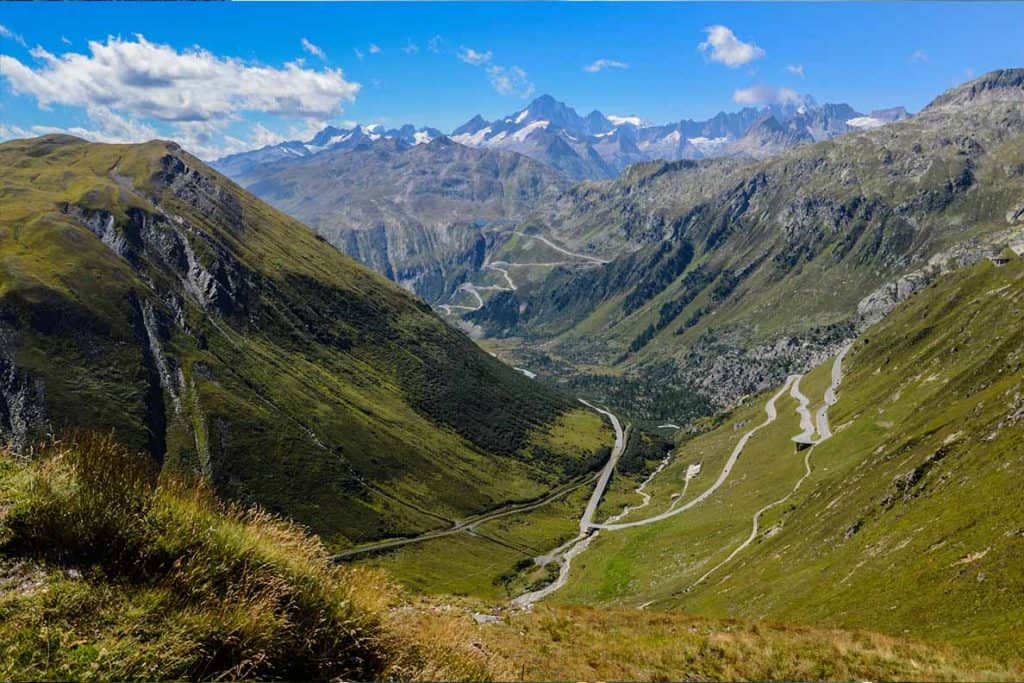
We took our first motorhome into Europe, through Italy and up into the Swiss Alps. On our second day in the Alps, we stopped at a little place called Gelmer for lunch and a trip up the terrifying Gelmerban funicular (a VERY old train which goes backwards up a mountain!)
Gelmer is halfway up a mountain in the Swiss Alps. Whichever way you go, you’re immediately driving on tiny, hairpin, mountain roads. And as soon as we set off, we realised there was something seriously wrong with our brakes.
We’d been wild camping in the Alps the night before- which was MAGICAL. But we’d been going up and down STEEP mountain roads for the past 24 hours and, unbeknownst to us, the brake fluid had boiled dry and completely disappeared!
Travelling in a motorhome- our mistake
When we bought the van 3 months earlier, we’d been told it had just had a full service and MOT. We did our own checks, but we never thought to check the brake fluid.
Turns out, it hadn’t been changed for many, many years and was mostly water- which meant it had evaporated over the past 48 hours as the brakes got hot.
All this led to us hurtling down a steep mountain, with a trailer pushing us even faster… and no way of slowing down except for our hand brake.
I am forever grateful that my ex husband was driving, not me. Honestly, I’m not sure I would have known what to do. There was nowhere to pull over, nowhere to stop and turning around wasn’t an option.
All we could do was continue down the mountain, trying desperately to slow down as we approached each hairpin turn and praying we didn’t catch up to a slow vehicle in front.
I couldn’t even speak, I was that scared. I just let my ex husband do his thing- which he did brilliantly. He used engine braking as much as possible- and the handbrake to supplement that. Yes, it ruined the handbrake. No, we didn’t care.
Travelling in a motorhome- the good part
At the bottom of the mountain was a small village (a fairly common sight when you’re driving in Switzerland). Just off the main road was a garage, and we pulled into the forecourt in a cloud of smoke.
The mechanics didn’t speak a word of English (why should they?!) but they did speak the universal ‘Oh’.
Oh indeed.
These guys were brilliant. They had several cars and jobs already in, but they stopped what they were doing to help us. The owner called his son, who came to help too, and they quickly replaced the brake fluid, changed the pads and checked wheels, tyres, handbrake (luckily not damaged) and fixed anything which needed fixing.
They also checked the oil and did a couple of other essential checks for us, as we no longer trusted the ‘service’ the motorhome had apparently had. Within a couple of hours, it was all done and sorted.

Travelling in a motorhome- my advice
Luckily, this story had a happy ending. We were ok. The van was ok. We bought a big crate of beer for the mechanics and headed off on the road again.
Still, it taught us not to trust salesmen!
Please please PLEASE, before you go travelling in a motorhome, get it fully checked by an independent mechanic- NOT the people you bought it from.
Especially if you’re planning to take your van overseas into some fairly harsh terrain. There’s a complete list of essential motorhome checks you should do HERE.
This story isn’t meant to frighten anyone from travelling, whether in a motorhome, a camper or a car. Heck, it didn’t put us off!
But I hope sharing our story (and mistake!) will help you avoid being in such a terrifying situation yourself. If you know anyone else who might benefit from a bit of friendly advice, feel free to share this with them on Facebook or Pinterest.
Want more tips for motorhoming?
Here are some more ideas you might find useful:
Want FREE checklists, eBooks and additional tips to help? Visit our resource page

Last update on 2025-12-13 / Affiliate links / Images from Amazon Product Advertising API

