


This article was featured in the One Story to Read Today newsletter. Sign up for it here.
When George Miller started dreaming up his first Mad Max movie, in the late 1970s, he had just a vague sense of the world it would be set in; he knew only that his independent debut feature would be action-packed and shot cheaply in the Australian countryside. The resulting film offers a recognizable vision of modern life with an eerie air of societal collapse, as the patrolman Max Rockatansky (played by Mel Gibson) does battle with raging motorcycle gangs on wide, empty roads. Two sequels, Mad Max 2 (1981) and Mad Max Beyond Thunderdome (1985), upped the apocalyptic intensity but cared little for continuity: Each new, and essentially unplanned, entry throws Max into wild vehicular action with ever more bizarre desert supervillains.
Miller helped fund Mad Max by working as an emergency medical doctor, and he was partly inspired by the chaos he witnessed on the job, as well as by accidents he saw growing up. The movie became the hit that defined his career. Although he’s worked on many other acclaimed films, such as The Witches of Eastwick, the Babe and Happy Feet films, and, recently, Three Thousand Years of Longing, Mad Max has always been his most important project. Now, 45 years after the original came out, he is releasing his fifth film in that cinematic universe: Furiosa, a prequel to Mad Max: Fury Road, his 2015 masterpiece. Fury Road restarted the series with a new lead actor, Tom Hardy, and teamed him up with a truck-driving road warrior named Furiosa, played by Charlize Theron. Furiosa builds out the carefully designed dystopia of its predecessor to explain the origins of its title character, now played by Anya Taylor-Joy.
To Miller, the continued existence of this franchise is something of a surprise. “I honestly never thought, after the first Mad Max, that I’d make another film. It was so tough,” Miller told me in an interview. “I was just lucky enough that it resonated with audiences, particularly internationally. I didn’t fool myself into thinking it was because I was particularly clever. It was because we had inadvertently tapped into some archetype, and I made it my business to understand what that was.”
In the intervening years, Miller’s portrayal of a future built around cars, guns, and oil, where the surviving humans engage in caveman-level violence behind the wheels of souped-up jalopies, has felt only more trenchant. The Mad Max movies have always understood the terror of looming environmental collapse, but there was something uniquely prescient about Fury Road, which is set around a mountainous fortress called the Citadel, run by a chalk-faced mutant named Immortan Joe. Leading a gang of radioactive soldiers called the War Boys, Joe controls his populace by pumping from the ground what little H2O remains, while warning the Citadel’s teeming masses, “Do not, my friends, become addicted to water!”
Fury Road’s horrifying depiction of a world bleached by climate change and peak oil, combined with its egomaniacal and ultra-patriarchal villains (Joe has a cadre of women in his dungeon whom he’s enslaved as “wives”), made it the perfect apocalyptic tale for the mid-2010s. “There’s a potential for the stories to be quite rich because they’re allegorical, in the same way that the American Western is basically allegorical,” Miller said. “It often would take about 10 years before a film is, to some degree or other, settled into the zeitgeist. That process is accelerating now, because information is flowing much more rapidly in all sorts of directions.”
Indeed, much of Fury Road has settled into the language of the internet, be it the War Boys uttering their nonsensical prayers to Valhalla, or Max grumbling, “That’s bait.” Perhaps its most distinctive creation, though, is Theron’s Furiosa, a hard-charging Valkyrie with a robot arm, a shaved head covered in motor oil, and a steely gaze. She comes out of nowhere in the movie, engineering the rescue of Joe’s wives and getting Max mixed up in the chaos. When Miller and his Furiosa co-writer, Nico Lathouris, conceived of Fury Road, they sketched out an entire backstory for her, creating a prequel screenplay that they considered filming simultaneously or perhaps turning into an animated work.
“Fury Road is [happening] almost in real time,” Miller told me. “All the exposition, all the backstory has to be on the run. In order to tell that, we had to know everything about everything—not only all the characters, the dynamics of the characters, about the world, but every prop, every gesture, every utterance had to be basically defined in some way.” The troubled, super-intense process of making Fury Road delayed any plans at a filmed prequel, however, animated or not. “We needed the story of Furiosa to tell the story of Fury Road, and we end up all these years later making it,” Miller said, adding that he was drawn back to the project because of how different it would be, in terms of pacing and rhythm.
Furiosa, though still full of action, is a sprawling, picaresque saga set over 15 years, a departure from the intense burst of adrenaline that is Fury Road, which takes place over a few days. The new film follows Furiosa (played as a girl by Alyla Browne and as an adult by Taylor-Joy) as she’s kidnapped from her verdant homeland by a biker warlord named Dementus (Chris Hemsworth), who then begins a pitched, decade-long series of battles with Immortan Joe for control of the expansive territory known as the Wasteland. The film follows Furiosa as she bounces from Dementus to Joe, working alongside the War Boys and eventually coming under the wing of a soldier named Praetorian Jack (Tom Burke), who teaches her the way of the road warrior as she seeks vengeance against her kidnappers.
Whereas Fury Road throws the audience into action and never lets up, Furiosa takes its time and soaks in the details of Miller’s world. And where Fury Road is basically a jailbreak movie, Furiosa is a meditation on the limits of revenge—and it isn’t afraid to frustrate the viewer. “People are saying, I think in a good way, that it’s different from Fury Road. And that’s what you try for,” said Miller, who is used to making sequels that upend people’s expectations, such as the anarchically dark Babe: Pig in the City and the lovingly bizarre Happy Feet Two, which features Brad Pitt and Matt Damon as a pair of krill searching for the meaning of existence. “A story always needs something fresh so there’s no stasis in that evolution. And yet, it has to be familiar,” Miller said.
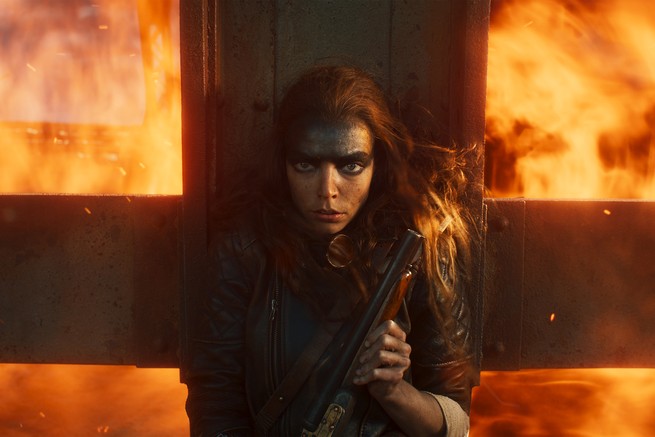
Much like Theron’s performance, Taylor-Joy’s is largely silent. Furiosa speaks some 30 lines of dialogue over the course of the film but communicates waves of emotion with a glare. For Miller, the most interesting characters in the history of cinema tend to be the laconic ones. “Furiosa says very few words because it’s necessary,” he told me. “She becomes a creature of action rather than words, which is basically the only thing that really means anything in the Wasteland.”
Furiosa’s penchant for silence also defines her perfectly opposite the self-important villain duo of Immortan Joe and Dementus. When designing Joe, Miller went as medieval as he could, putting him in the tallest tower and turning him into a godlike figure for those around him. “He basically operates in the way that many had through history, pre-20th-century technology; most of the demagogues used gravity as their competitive advantage,” Miller said. “Dementus, however, is a completely different animal. His competitive advantage is mobility, and, like all those characters through history, from the Romans to Genghis Khan to Hannibal, he’s marauding across the land.”
Whereas Joe gives brief, strongman speeches from high up in his Citadel, Dementus is a hyper-verbose, clownish creature, blessed with Hemsworth’s mighty physique but relying “much more on his charisma, which is aided by an unpredictability,” Miller said. “We don’t know which way he’s going to go. He’s always intriguing to watch, dangerous, and he uses humor. He’s a trickster, which is [another] common character in stories.” The quiet Furiosa, then, seems all the more heroic in comparison, saying nothing and seething as Dementus tries to justify his wickedness in monologue after monologue.
“What I’ve learned from animation and filmmaking and trying to understand the rhythms of cutting is that … humans are reading faces,” Miller said. He described cinema studies in which researchers track viewers’ attention to determine which part of the screen they’re focusing on during a movie—“almost inevitably, they’re looking at the eyes.” Furiosa has a complex view of the world its hero is navigating, but it has a stark, simple take on how to know whom to trust: just stare into their eyes. “It’s prehuman,” Miller told me. “It’s something that we need for our survival and understanding.” That’s what makes Furiosa his perfect screen hero: She’s the star of a modern blockbuster but sprung from the earliest, sparest days of cinematic language, conveying everything she needs to with a look.

