


SAN FRANCISCO — At a Walgreens in this city’s bustling Japantown neighborhood, pharmacist Margaret On stocks two boxes of long-acting insulin pens from California’s new prescription drug label, CalRx, emblazoned with the state’s iconic grizzly bear.
Although she hasn’t dispensed any, On plans to keep them on hand. “It’s good to have if a patient comes in and doesn’t have health insurance,” she said. “Or just in case of emergencies.”
Seven months after the launch of its own low-cost insulin brand, state health officials said California has distributed more than 120,000 five-pen packs of insulin glargine priced at $55 each, significantly less than the $89 to $411 that the state says most popular brand names charge before any retail markups or consumer discounts.
While it represents a tiny amount of the state’s insulin pipeline, it marks the first time a state is competing against the three biggest insulin drugmakers — Eli Lilly, Sanofi, and Novo Nordisk — under its own prescription drug label. CalRx, Gov. Gavin Newsom’s experimental initiative, has dual aims: to act as an emergency supplier for people who are uninsured or can’t afford their prescriptions, and to disrupt the nation’s deep-pocketed pharmaceutical industry, which cost the U.S. $467 billion in 2024, the federal government reported in June.
Newsom, a Democrat considering a presidential run in 2028, is expected to make healthcare a central pillar of his national platform as he concludes his second and final term as governor. To create the state brand of generic drugs, California inked a $50 million contract with Civica, a Utah-based nonprofit drugmaker, to develop the CalRx insulin, known as a biosimilar. Though major distributors make the drug available in pharmacies around the state, uptake has been limited.
Newsom’s goal is to saturate the insulin market and offer generic versions of drugs either high in cost or low in supply, or that can improve public health. The state is also distributing free naloxone, used in a nasal spray to reverse opioid overdoses, and trying to bring albuterol inhalers to public schools for students with asthma emergencies. In the next two years, the state plans to launch epinephrine injectables, commonly known by the brand name EpiPen, which are used to treat severe allergic reactions, as well as a state-branded medication to treat tuberculosis.
Before he leaves office in January, Newsom said, he wants to add generic GLP-1 medications to compete with brand-name drugs such as Ozempic and Wegovy. The drugs have exploded in popularity, but employers have raised concerns about their cost.
Taking on drug costs is a winning political issue for both Democrats and Republicans, who have for years tried to rein in soaring healthcare spending as Americans feel the pinch of high prices at pharmacy counters, in doctors’ offices, and from health insurance premiums. The U.S. spends roughly twice as much per capita on prescription drugs as other industrialized countries. Six in 10 adults in the U.S. say they’re worried about being able to afford their prescription drug costs, according to a poll last winter by KFF, and 4 in 10 say they’ve tried to save money such as by skipping doses and not filling prescriptions.
In February, President Donald Trump launched TrumpRx to potentially lower out-of-pocket costs for consumers. But TrumpRx doesn’t produce drugs; rather, it directs consumers to find more affordable medications with coupons or on drugmakers’ websites. Newsom, in contrast, is trying to drive down the underlying price of medicines by increasing the manufacturing and availability of generic drugs.
While some people with diabetes may benefit from CalRx insulin, California’s generic drug effort is largely symbolic at this time, said Geoffrey Joyce, director of health policy at the Schaeffer Center at the University of Southern California. “There is some value, but it’s for a very limited number of drugs for just a fraction of the population,” Joyce said.
And TrumpRx isn’t helping at a large scale either, Joyce added, because many medications it advertises have cheaper generic versions available elsewhere. It would be better, he said, to develop large-scale initiatives that tackle key drivers of the high cost of drugs, for rare cancers for instance, and produce safer and higher-quality medicines.
“What you really need is a national effort that focuses on vulnerabilities like supply shortages and increasing the supply of generic products for higher-priced drugs,” Joyce said.

Market Disruptor
CalRx aims to make insulin more affordable and accessible for the nearly 3.7 million California adults diagnosed with diabetes. Newsom last year singled out the three major drugmakers that control more than 90% of the global insulin market, while also targeting intermediaries known as pharmacy benefit managers for promoting higher-priced drugs over cheaper generic alternatives.
Patients with health insurance often receive discounts at the pharmacy counter and do not pay sticker prices, yet those discount programs can be hard to navigate and patients can face restrictions. While drugmakers and pharmacy benefit managers said they’ve already initiated $35-a-month caps on out-of-pocket costs and pass price discounts on to consumers, Newsom argues that consumers still struggle to afford their medications.
He has criticized pharmaceutical companies for gouging Californians and contended that the industry’s discounting schemes don’t adequately address inflated prescription drug spending, which in the U.S. rose 7.9% in the most recent reporting year.
In his announcement last year that CalRx insulin would go on sale in January 2026, Newsom said the industry had been using discounts to distract consumers from solutions that could bring overall prices own. “One of the things that all of us should be increasingly concerned about is announcements around caps, announcements around discounts,” he said.
In January, California joined dozens of other states in setting insulin price caps. It also passed a law attempting to ban price inflation practices by pharmacy benefit managers.
Representatives for drug companies and pharmacy benefit managers said insulin is largely an affordable medicine in the U.S., arguing that consumers have benefited from discounts.
“While insulin prices, set solely by pharma companies, may be high in some instances, the amount patients are paying out of pocket has declined significantly,” said Christine Rex, senior director of state public affairs for the Pharmaceutical Care Management Association, which represents pharmacy benefit managers.
Reid Porter, a spokesperson for Pharmaceutical Research and Manufacturers of America, which represents brand-name drugmakers, said PBMs have driven up costs for consumers by excluding lower-cost medicines from their lists of covered drugs. “Too often, patients face a system in which insurers and PBMs exclude coverage of those medicines on formularies because of supply-chain incentives,” he said.
Where To Find CalRx Insulin
CalRx insulin has been slow to reach pharmacies around the state, and in interviews, patient advocates said many people with diabetes aren’t aware it’s an option.
In Sacramento, pharmacist Sharon Ngo, who works at a Safeway pharmacy, was surprised to learn that California had a long-acting insulin product on the market. She didn’t know that CalRx insulin was interchangeable with Lantus, which was on back order for roughly two weeks.
“I had no idea this was available,” she said as she took notes on a pad of paper. “We’re going to give this a try.”
CalRx insulin has a suggested retail price of $55 a pack and is available with or without insurance. California has inked deals with four health insurers to cover CalRx insulin on their health plan formularies, potentially making it cheaper, depending on copays. They include Anthem Blue Cross, Blue Shield of California, the Valley Health Plan for Santa Clara County employees, and the Federal Employees Health Benefits Program, according to the state Department of Health Care Access and Information.
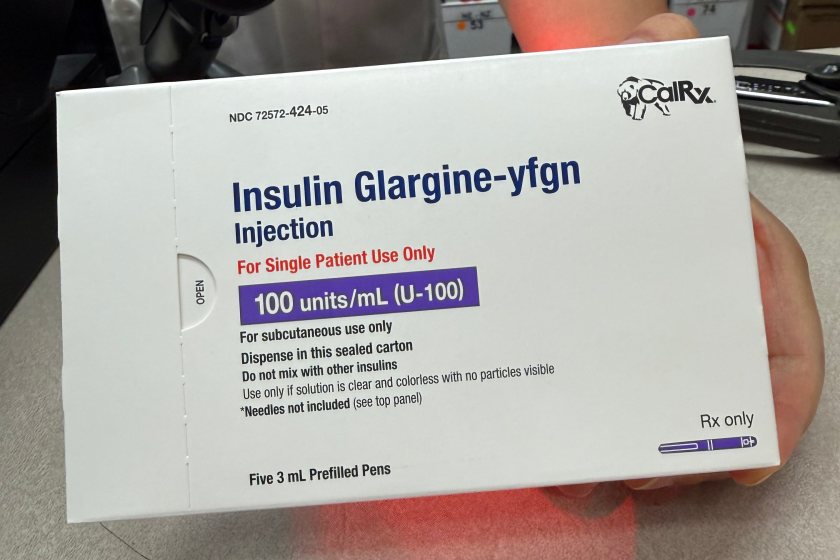
Elizabeth Landsberg, the department’s director, said the state is working to get more insurers to cover CalRx insulin and to provide it at more pharmacies. The state doesn’t know how many boxes have been dispensed. However, Landsberg said it was more meaningful that the state had reached agreements with three major pharmaceutical wholesalers to distribute its product in California. Currently, CalRx insulin is available on Amazon and at Costco, as well as at some retail and grocery store pharmacies including CVS, Walgreens, and Walmart.
“What we’re really trying to do is change market behavior and offer both affordable and transparent pricing,” Landsberg said. “The rebates and discounts are hard for consumers to understand and can change at any time, so we are trying to be straightforward and say, ‘Let’s not play this shell game anymore.’”
Allan Coukell, chief government affairs and public policy officer at Civica, said the company first partnered with the state on long-acting insulin that helps patients keep blood sugar steady for 24 hours or more. Next, it plans to help California develop rapid-acting insulin, which is used to pull elevated glucose down within minutes, to compete with brand names such as Humalog and NovoLog.
Health insurance companies welcomed the state’s efforts, in part because they could help save money they pay out on prescriptions.
“Making this drug available is really about helping people improve their health,” said Paul Markovich, CEO of Blue Shield of California’s parent company. “And the more supply we can get on the market, the more we can get rid of the profit motives in the pharmaceutical industry.”
One July afternoon in the Southern California city of Corona, Chris Noble went to a CVS pharmacy to get a box of CalRx insulin. The pharmacist didn’t have any on hand, but Noble, a healthcare organizer with Type 1 diabetes, was told he could get a prescription filled in 24 hours.
“I have insurance, but I see myself using this if I’m traveling and something happens like my insulin pump malfunctions,” he said. “Now I know I can go to a CVS and get insulin within a day.”

