


If you’ve seen the name Trilivy pop up on social media lately, don’t worry – you haven’t missed anything new. Trilivy is simply a rebranding of the Optavia program, which I reviewed here.
Before Optavia, the company was Medifast. Both brands were focused on one thing: rapid, significant weight loss through dramatic, unsustainable (for the majority of people) calorie deficit. I’ve had quite a few ex-Optavia users come to me for weight loss, and I can confidently say that the negative effects of this program – physically and emotionally – touched each and every one of those individuals.
You can’t base your diet on tiny portions of unpalatable, shelf-stable food and expect to learn and maintain healthy habits for the long term. Optavia also utilized ‘coaches’ to guide users through the program. Coaches were simply people who had gone through the program. They had inadequate training in basic physiology, nutrition, and behaviour change, making them absolutely unqualified to help anyone with their nutrition.
But is Trilivy actually a new program, or is it just another version of Optavia, wrapped up in new marketing? Let’s take a look.

What is Trilivy?
Unlike Optavia, which was a hard-core weight loss program, Trilivy is marketed as a ‘metabolic health’ program. Marketing reveals plenty of vague wellness buzzwords about reversing metabolic dysfunction, resetting your metabolism, improving metabolic flexibility, and improving healthspan.
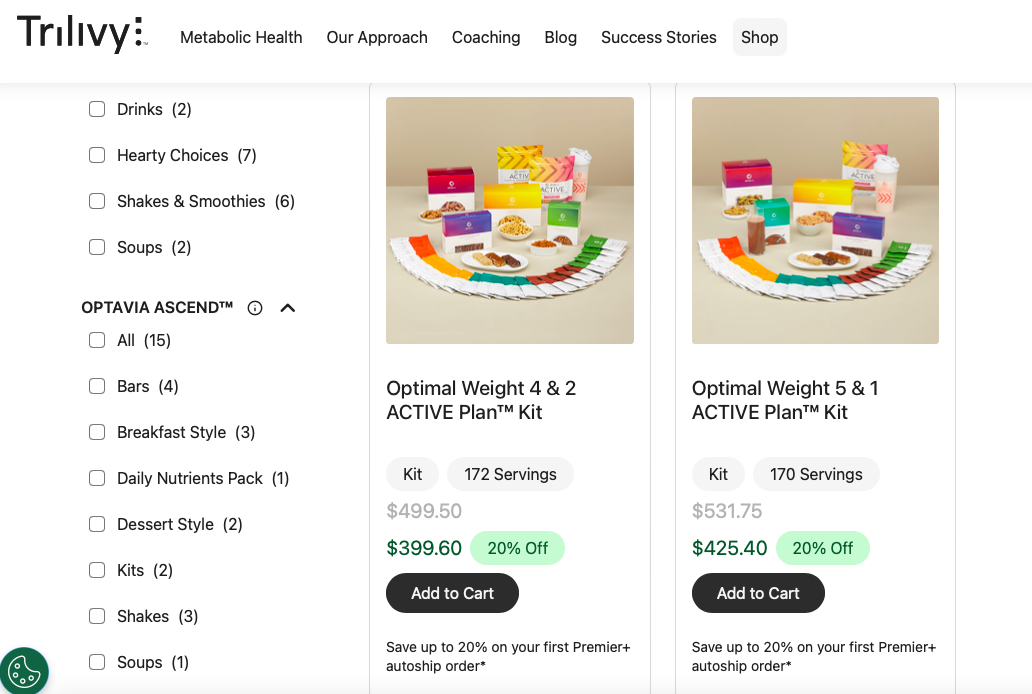
Trilivy is a 3-step commercial nutrition program. In its first two steps, Trilivy is mostly based on packaged, pre-portioned meals called ‘fuelings.’ Each fueling ranges in calories from 100-110. How many fuelings you get per day depends on which step you’re on, and your caloric needs as determined by Trilivy.
Trilivy offers most of the same plans that Optavia had, including 5 & 1 and 4 & 2. For example, for 5 & 1, this means, 5 ‘fuelings,’ and one ‘lean and green’ meal.
Trilivy’s 3 steps aren’t a new format; They’ve taken the Optavia three-step structure and rebranded it:
Step number one is Reset, which is the same as Optavia’s 5 and 1 program. It’s based on 5 reset fuelings and one ‘lean and green’ meal, and delivers 800-1000 calories a day. Clients are on this step until they reach their goal weight, which can be an extended period of time. This is a red flag. Reducing weight by literally starving yourself never works for the long-term, and can result in nutrient deficiencies, gallstones, low mood, poor sleep, and many more issues. People do go on these types of diets, but they’re meant to be short-term, for a specific purpose, and closely monitored by a physician. This is not that.
The second step, Refine, is 2 fuelings and 2 lean and green+ meals, which are less restrictive than the normal lean and green meals. Calorie budget varies, but note that half of your intake in this step is based on prepackaged food. Refine is similar to Optavia’s transition phase, which lasted three weeks and gradually increased calories from approximately 900 to 1,200 kcal/day. Trilivy’s Refine phase appears to serve the same purpose, but the company no longer publicly specifies a fixed three-week duration or a standard calorie target, instead stating that intake is individualized according to Total Energy Expenditure.
Renew is akin to a maintenance step, which is mostly whole foods with a focus on behaviour change. Again, calorie budget is individual. You’re supposed to be on Renew forever.
Trilivy fuelings.
Trilivy/Optavia fuelings are notorious for being tiny, expensive, and unpalatable. The only thing that has changed between programs is that Trilivy fuelings contain proprietary ‘MetaVantage technology’: a combination of postbiotics, chromium, and choline. The company claims that these ingredients support metabolism and insulin function, although there is no actual research on the product to back that up. A lot of weight loss supplements contain these ingredients, but when it comes to their role in health and weight loss, the evidence is unremarkable at best. Also: fuelings are ultra-processed food, no matter which way you slice it. And even if you’re ‘allowed’ 5 fuelings a day, that’s only around 500 calories.
Trilivy research?
The research study that Trilivy uses to back up its claims is the exact same 2018 paper that was used by Optavia for the same purpose. (PMID: 30820327). It’s a 16-week trial that used Optavia fuelings and phone-based nutrition coaching versus the low-calorie Medifast diet, versus a self-directed low-calorie diet. The self-directed group was considered to be the control group. 198 people, 80% women and average BMI of 34, participated.
Of course, the Optavia and Medifast groups lost significantly more weight over the 16 week span, because those diets are what I’d consider as a dietitian to be VLCDs – very low calorie diets.
The Optavia group got 800-1000 calories a day.
The Medifast group got 1100-1300 calories a day.
What did the self-directed group get? The researchers used the USDA Body Weight Calculator to give each participant a calorie budget with the goal of achieving a 7% weight loss over the 16 weeks. I was curious to see how that would stack up next to the other groups, so I used the 7% goal, plus the average age, height (not given but calculated using average BMI), and starting weight of all the participants (224lb) in the tool to see what it came up with .
2068 calories per day. That’s the answer.
Who do you think is going to lose more weight, the groups eating under 1300 calories per day, or the group eating 2068 calories per day?
You know where this is going: the study was trash. Yes the company trots it out at any opportunity, probably counting on the fact that most people won’t read it or understand how bad it is.
Is Trilivy an MLM?
Yes, Trilivy is sold with a multi-level marketing model. Just in case you’re wondering how I feel about MLMs, you can read what I wrote about them here.
Who are the Trilivy coaches?
90% of Trilivy coaches are former Optavia/Trilivy users. I once used a lawyer, does that mean I’m qualified to defend someone in court? Of course not. And merely going through a program does not in any way qualify someone to counsel for weight loss or health. In fact, managing the complexity of the physical and emotional issues that clients can experience when trying to lose weight and/or change their diet, is well beyond the scope of any layperson.
It particularly irks me that some of the coaches brand themselves as ‘metabolic reset coaches.’ What is that, even? Check out this post from a Trilivy coach:

Following the link in the person’s profile brings me to a ‘My Metabolic Scan’ test that supposedly gives you some insight into your metabolic health. Except it doesn’t do that at all. The test is unvalidated, and although it isn’t branded, it’s an unmarked sales and marketing tool for Trilivy that’s meant to get your contact info. Sneaky.
Also: why do so many nutrition MLM coaches feel the need to be covert about the fact that they’re selling a product, at least in their social posts? Do they think they have to dupe people into engaging with them? That tells us a lot about these companies, their coaches, and their deceptive marketing strategies.

Coaches do get some training from Trilivy, but it is not equivalent to an accredited healthcare education or professional licensure. All it does is prepare coaches to deliver the program, rather than to provide individualized medical nutrition therapy. But you know that clients will be looking for more than just program delivery, which puts these coaches in a very precarious, high-liability situation.
But that’s not all: the coaches actually sell the product, too. This is a conflict of interest beyond any doubt.
Why did Optavia rebrand to Trilivy?
I can think of several reasons why the company would rebrand. The first is obviously that Optavia had some pretty heavy reputational baggage. In their ranking of diets, U.S. News and World Report gave Optavia 2.8 stars out of 5; the reviews on Reddit, Trustpilot, and across social media are also low, often citing cost, hunger, dependence on ultra-processed fuelings, and the unsustainability of the program.
The diet landscape has also changed. With the popularity of GLP-1 medications, commercial diet companies have to fight tooth and nail for every customer – especially if they aren’t offering the medications. Perhaps the rebrand is to bring in unsuspecting buyers who would otherwise reject the Optavia program because of its bad press.
Is Trilivy worth trying?
Absolutely not, in my opinion.
Any program that cuts calories this drastically for any reason, isn’t sustainable or evidence-based. Yes, you’ll lose weight and your metabolic markers will probably improve. However, this will be short-lived once you get tired of eating astronaut food or following the program rules, whatever the stage.
The use of the same horribly done research study over and over again shows that this program and its predecessors don’t have a lot to offer in terms of evidence for their efficacy. I find it off-putting that they’d mislead their potential clients with this ‘research.’
Eating food that’s prepackaged doesn’t teach you how to self-manage. Neither do coaches who are utterly unqualified to give nutrition advice.
Trilivy doesn’t appear to be any better than Optavia, even with the new focus on metabolic health. At its heart, Trilivy seems like just another restrictive, expensive weight loss diet.

