


California employers received significant health insurance news: Health Net, a Centene company, is exiting the commercial small- and large-group health insurance market.
If your company currently offers Health Net coverage, don’t panic. Coverage is not ending immediately. However, employers should start reviewing alternatives now rather than waiting until the last minute.
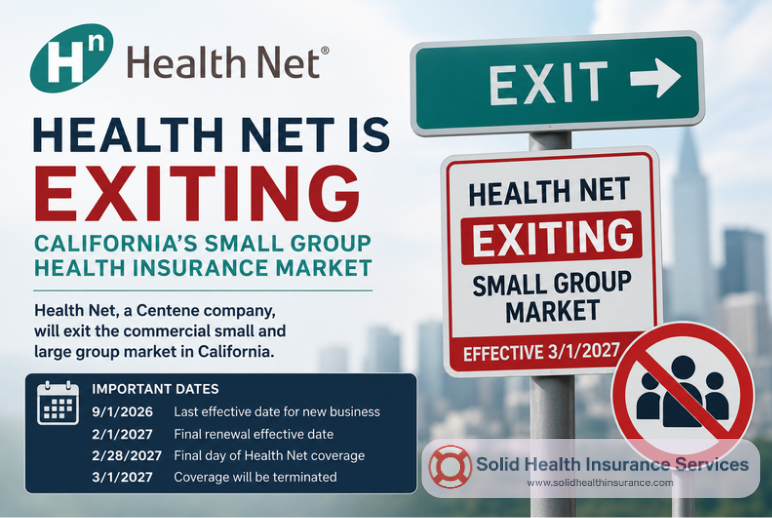
Important Dates for Health Net Employers
Here is what we know so far:
- September 1, 2026: Last effective date for new Health Net group business
- February 1, 2027: Final renewal effective date
- February 28, 2027: Final day of Health Net coverage for affected small and large groups
- March 1, 2027: Remaining affected group coverage terminates
The announcement applies to Health Net’s commercial small- and large-group business.
Health Net is not disappearing from California altogether. Its individual Marketplace/Covered California, Medi-Cal and Medicare businesses are separate from this commercial group-market exit.
Why Is This Happening?
Health Net’s announcement comes at a time when the entire health insurance industry is dealing with rapidly rising medical costs.
A recent analysis by Mark Farrah Associates found that U.S. health insurers reported approximately $10.4 billion in underwriting losses in 2025, compared with $1.7 billion in 2024.
An underwriting loss happens when an insurance company spends more on medical claims and related expenses than it collects in premiums.
In simple terms: the cost of health care is rising faster than premium revenue in several parts of the insurance market.
What Is a Medical Expense Ratio?
One way to understand what is happening is to look at an insurer’s medical expense ratio.
The medical expense ratio compares how much an insurance company collects in premiums with how much it spends on medical care and claims.
Here’s a Simple Example
Imagine an insurance company collects $100 in premiums.
If it spends $88 on medical claims, its medical expense ratio is 88%.
That leaves $12 to help pay for administration and other operating expenses and, potentially, profit.
Now imagine medical costs increase and the insurer has to spend $93 of every $100 it collects.
Its medical expense ratio rises to 93%, leaving only $7 for everything else.
That difference may sound small, but across millions of members and billions of dollars in premiums, it can have an enormous financial impact.
This is why a rising medical expense ratio matters. When medical expenses increase faster than premiums, it becomes more difficult for insurers to keep premiums and benefits at the same levels.
Employer Health Plans Are Feeling the Pressure Too
The problem isn’t limited to individual or Medicare insurance.
In the employer-group market, insurers covered approximately 41.4 million members at the end of 2025.
The average medical expense ratio increased from 88% in 2024 to 89.7% in 2025.
In other words, for every $100 in premium revenue, nearly $90 was going toward medical expenses on average.
For employers, these industry pressures can eventually show up through higher premiums, changes in plan designs, narrower provider networks or changes in carrier participation.
Health Net’s exit is an important reminder that employers should not assume the carrier or plan they have today will always remain available.
It’s Not Just Group Health Insurance
Other areas of health insurance are also experiencing financial pressure.
The Individual health insurance market saw its average medical expense ratio increase significantly, from 85.3% to 93.2% in 2025.
Medicare Advantage also experienced rising costs. Medical expenses increased 18%, compared with a 16.1% increase in premiums earned. Its average medical expense ratio increased from 89.5% to 91%.
This does not mean health insurance or Medicare Advantage is going away.
It does mean insurers are under increasing pressure to balance premiums with the growing cost of providing medical care.
What Should Health Net Employers Do Now?
If your business currently has Health Net, start planning early.
There is no reason to wait until February 2027.
Replacing a group health plan isn’t simply about finding another carrier with a similar monthly premium. Employers should compare:
- Doctors, hospitals and provider networks
- Prescription drug coverage
- HMO and PPO choices
- Deductibles, copays and out-of-pocket costs
- Employer contributions
- Employee costs
- Overall benefits
The cheapest plan isn’t necessarily the best plan for your employees.
Starting early gives you time to compare your options and make a thoughtful decision without rushing as the termination date approaches.
Even If You Don’t Have Health Net, Review Your Coverage
Health Net’s announcement is also a good reminder for all California employers to review their group health benefits at renewal.
With medical costs continuing to rise, the plan that worked well last year may not be the most competitive choice today.
A good benefits review should look at cost, coverage, provider access and the needs of your employees—not just the renewal percentage.
Solid Health Insurance Can Help You Prepare
If your company currently offers Health Net group health insurance, now is the time to start looking at alternatives.
At Solid Health Insurance Services, we help California small businesses compare group health insurance options from multiple carriers.
We can help you review available replacement plans, monthly premiums, employer contributions, doctor and hospital networks, prescription coverage, and HMO and PPO options.
Our goal is to help you find coverage that works for your employees and your company’s budget.
Don’t wait until Health Net coverage ends. Please contact us or click here to schedule a meeting with us today for a group health insurance quote and comparison.
Your Health Matters. Your Budget Matters.

